Slack Just Became Your AI Strategy. Most Haven't Noticed.
Salesforce rolled out 30+ new AI features for Slack, repositioning it as the operating system for how humans and AI agents work together. If you're thinking about your AI strategy through a CRM lens, you're already behind.
Slack Just Became Your AI Strategy. Most Haven't Noticed.
April 10, 2026
On 31 March, Salesforce rolled out 30+ new AI features for Slack, the biggest overhaul since the $27.7 billion acquisition in 2021. Marc Benioff stood in front of a room at the St. Regis in San Francisco and essentially said: Slack is now the backbone of the Agentic Enterprise.
And buried inside that announcement is a strategic shift that most enterprise leaders are completely sleeping on.
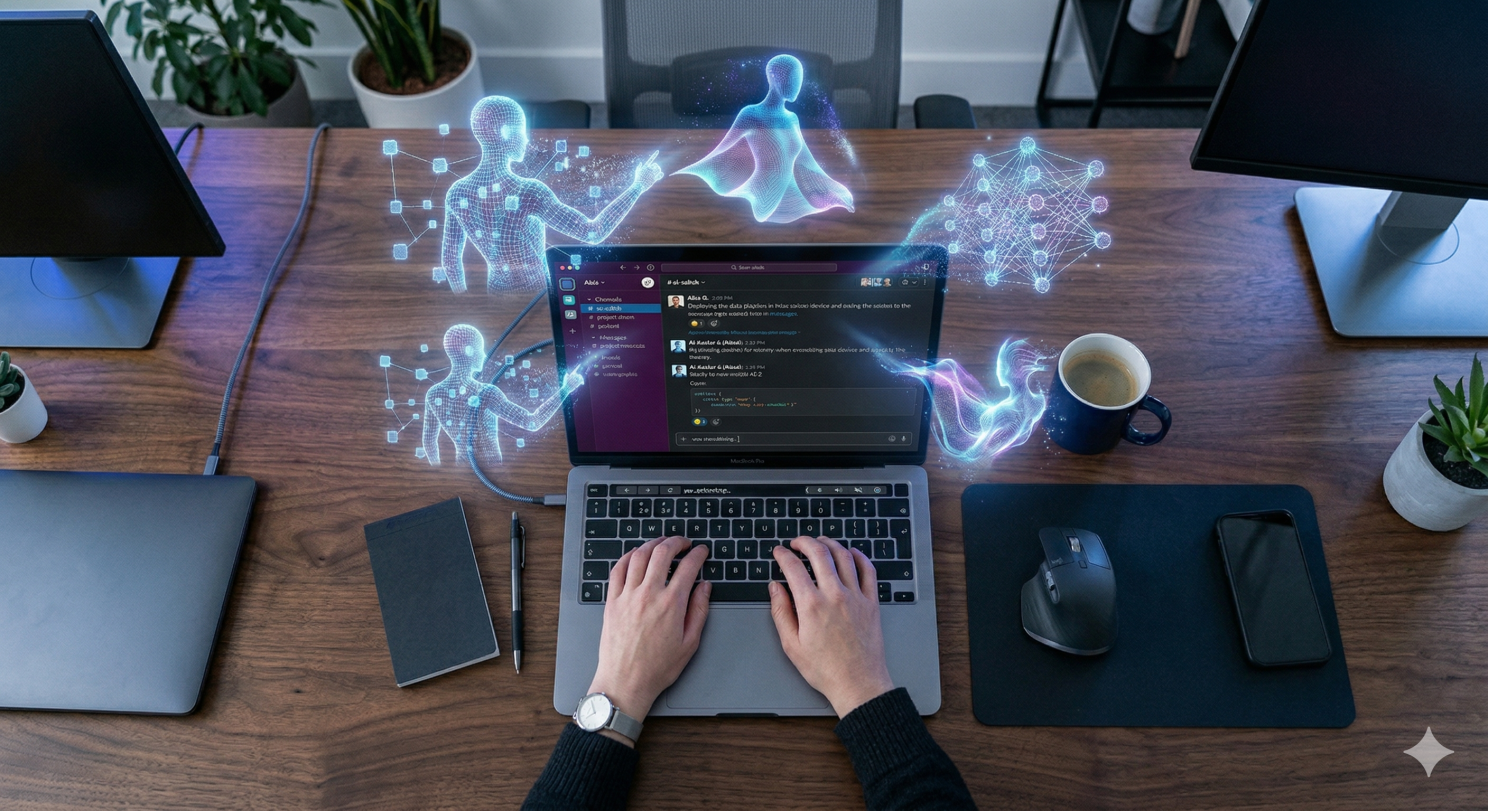
This isn't about a chat app getting some AI sprinkles. This is Salesforce repositioning Slack as the operating system for how humans and AI agents work together. If you're still thinking about your AI strategy through a CRM lens, you're already behind.
What Actually Changed
Let's cut through the noise.
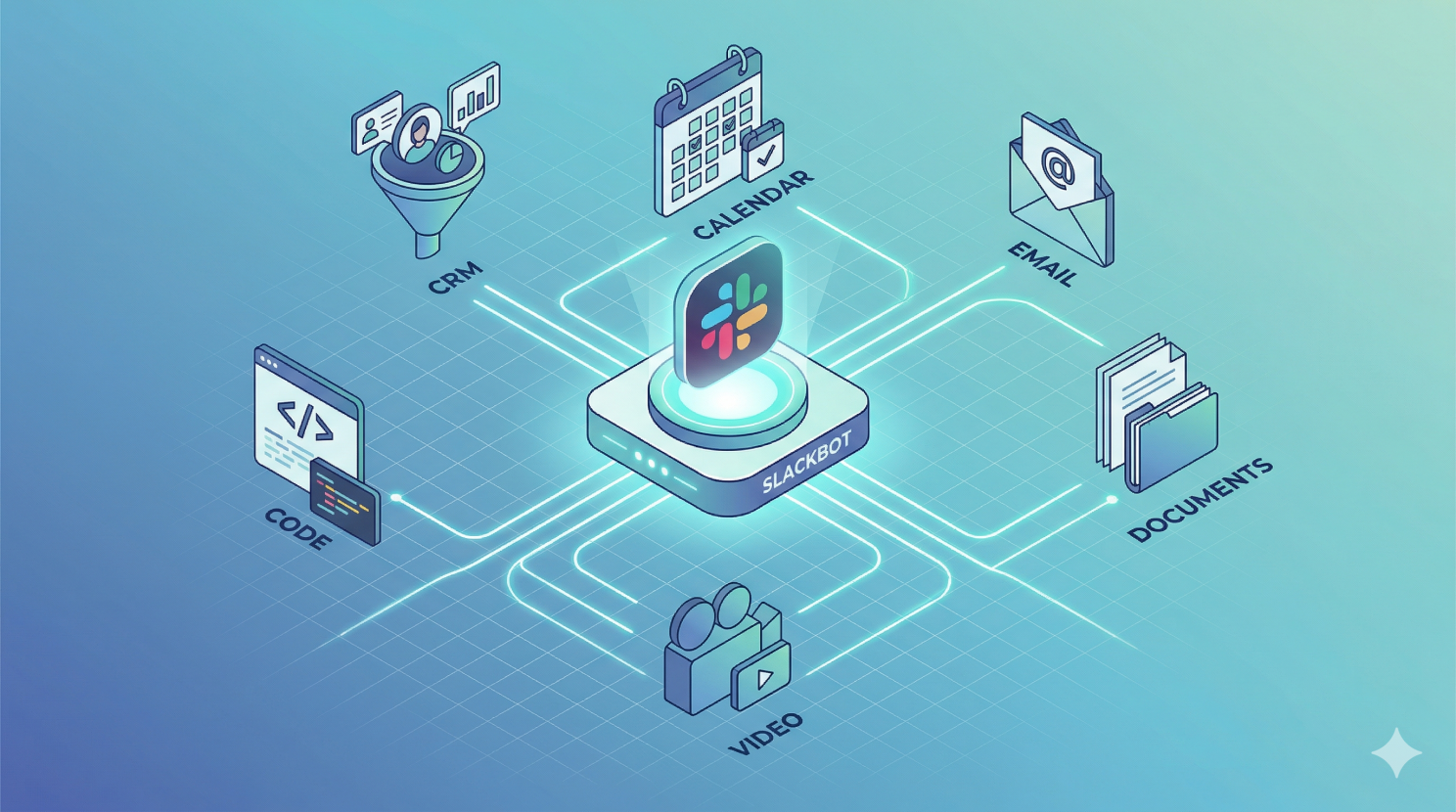
The old Slackbot was a glorified notification machine. The new one, powered by Anthropic's Claude, functions as a genuine agentic assistant. It operates as an MCP (Model Context Protocol) client, meaning it connects to and orchestrates across 6,000+ applications — Agentforce, Google Workspace, Microsoft 365, Notion, Workday, ServiceNow, you name it.
Here's the bit that matters: Slackbot now acts as a universal router. You give it a goal, and it figures out which connected agent or tool is best suited for the job. No more context-switching. No more training users on yet another interface.
It can also transcribe meetings across Zoom, Google Meet, and Huddles, then log action items straight into your CRM. It monitors your desktop activity (with user-controlled permissions) and makes contextual suggestions. And there's a new feature called AI-Skills, reusable task definitions that Slackbot can recognise and execute automatically. Think "summarise this campaign brief" or "generate a budget plan," saved once, used everywhere.
Oh, and from this summer? Slack gets bundled with every new Salesforce customer automatically.

The Real Strategic Play
Here's what I think most people are missing.
For years, the enterprise software battle was fought on CRM territory. Salesforce vs Dynamics vs HubSpot. AI agents were bolt-on features. That paradigm is dead.
The new battleground is the conversational interface. Whoever controls where humans interact with AI agents controls the workflow, the data access, and ultimately the enterprise. Salesforce just made its move, and it's a clever one. They're not asking a million organisations to adopt a new AI platform. They're transforming the collaboration tool those organisations already use every day.
Gartner's analysts put it well in their first-take brief: Slackbot converts Slack's prior AI-enabled team workspace into an AI-first work hub, where interactions increasingly start with or involve AI.
That's a fundamental shift from "tool you chat in" to "platform where work gets orchestrated."

The Pricing Chess Match
The cost dynamics here are worth paying attention to.
Slack AI is now included at no extra cost on Business+ and Enterprise+ plans. Meanwhile, Microsoft Copilot adds $18–30 per user per month on top of your existing Teams licence. For a 50-person team, that's the difference between roughly $7,500/year (Slack Business+ with full AI) and $14,000–16,000/year (M365 Business Basic plus Copilot).
Salesforce chose Anthropic's Claude partly because it was the only AI provider meeting FedRAMP Moderate certification when they were designing the system. That's not a trivial detail for anyone selling into regulated industries: government, healthcare, financial services. It's a deliberate play for the enterprise trust conversation.
But there's a catch worth flagging: Slackbot on Business+ is capped at 15 messages per week. If you're serious about using it as your daily AI companion, you need Enterprise+, which means 100+ seats and a price tag that starts climbing annually. The "included at no extra cost" messaging is technically true but practically misleading for smaller organisations.
Why APAC Executives Should Care Right Now
Here's the conversation I keep having with enterprise leaders across the region:
"How do we add AI to our Salesforce instance?" "What AI features should we enable?" "How do we train our sales team on AI tools?"
Wrong questions. All of them.
The right question is: How do we architect our entire digital workplace for human-AI collaboration?
Your collaboration platform choice is now inseparable from your AI strategy. Full stop. The platform you choose determines how employees interact with AI agents, which capabilities you can deploy, how AI integrates with existing systems, and how fast AI adoption spreads across your organisation.
Organisations still treating collaboration platforms as "just comms tools" are going to end up with fragmented AI initiatives that never scale. I've seen it happen already, three different AI copilots across three different departments, none of them talking to each other, none of them grounded in the same enterprise data.
The Competitive Landscape Is Moving Fast
Microsoft has been pushing Copilot hard for two years. There's a Copilot button on new keyboards, for crying out loud. But the market reception has been lukewarm. Microsoft themselves seem to be acknowledging that they haven't won the battle for the ultimate AI assistant, and they're searching for a new direction.
Google is enhancing Workspace with agent capabilities. OpenAI, Anthropic, Perplexity, and others are building agents that live natively inside Slack via MCP. Even smaller players are trying to create AI-native collaboration platforms from scratch.
The winners will be platforms that can seamlessly blend human collaboration with AI agent participation, where the interaction feels natural rather than bolted on. Slack has a genuine head start here because chat-based AI interaction in a chat platform is inherently less jarring than an AI sidebar in a spreadsheet.
What You Should Actually Do About This
Forget the generic "develop an AI strategy" advice. Here's what's practical:
If you're already in the Salesforce ecosystem: This is your moment. The Slack transformation gives you a ready-made path to enterprise-wide AI deployment using infrastructure you already own. Don't waste it by treating Slack as just your messaging app. Start exploring Agentforce agents deployed through Slack. Build AI-Skills for your most repeated workflows. Get your IT team to connect Enterprise Search across your document systems.
If you're on Microsoft 365: Don't panic, but do the maths. Copilot's cross-suite AI is genuinely powerful if your teams live in Word, Excel, and PowerPoint daily. But if 80% of your work communication happens in chat, the value equation shifts dramatically. At minimum, audit whether you're paying for AI capabilities your people aren't actually using.
Regardless of platform: Audit your collaboration stack with AI deployment in mind. Map which workflows could include AI agents as active participants. Identify the data silos your current collaboration platform can't reach. And start thinking about governance, because when AI agents are executing tasks across your enterprise, someone needs to be responsible for what they do.
The Bigger Picture
This shift represents something larger than a product update. It's the convergence of collaboration, automation, and intelligence into a single platform experience. The "Agentic Enterprise" isn't a buzzword, it's an operating model where AI agents actively participate in workflow and humans collaborate with them as team members.
Salesforce has made a bold bet that Slack is where that convergence happens. Whether they're right remains to be seen. But the strategic question isn't whether AI agents will transform how we work. It's which platform will orchestrate that transformation in your organisation, and whether you'll have a say in that decision, or whether it'll be made for you by default.
The organisations that recognise this shift early will have a genuine advantage. Everyone else will be playing catch-up with disconnected AI initiatives that never achieve enterprise-scale impact.
And in my experience, playing catch-up in enterprise AI is a lot more expensive than getting it right the first time.
---
Robin Leonard is a Salesforce and Agentforce consultant helping APAC organisations navigate AI and digital transformation. He specialises in architecting scalable solutions that drive real business outcomes.