

"Mate, we've already let go of forty people because of AI."
A friend of mine, a CTO at a mid-sized company, said this to me last week over a flat white in a Sydney cafe. I asked which AI was doing their jobs.
He stirred his coffee. Long pause. "Well, we're still mid-project. But it's coming."
That, right there, is the entire problem with how most companies are doing AI in 2026.

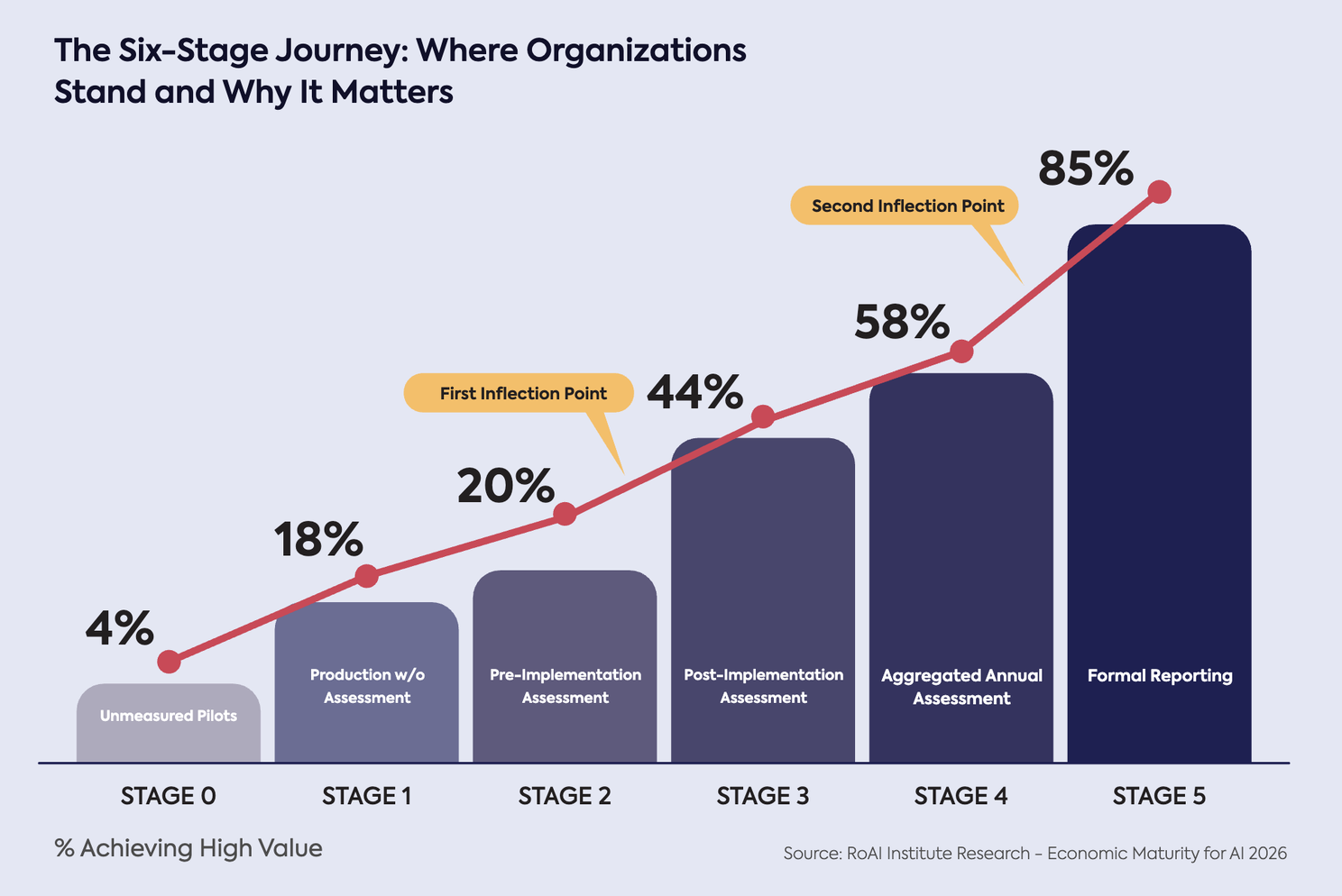
A new report from the Return on AI Institute surveyed 1,006 C-suite executives across 11 countries and 32 industries. The headline most people will run with is their six-stage AI Economic Maturity Model, which finds that organisations who formally report AI value to their boards capture a great deal of value 85% of the time, versus just 15% for the unmeasured-pilot crowd at the bottom.
Genuinely useful stuff. But it isn't the most important finding in the report.
The most important finding is this. Thirty times more organisations have cut headcount in anticipation of AI than from any actual AI implementation.
The numbers
Only 2% of the surveyed firms have made large headcount cuts tied to AI that's actually in production. But nearly 90% have either reduced or frozen hiring in anticipation of AI capabilities they have not yet built. Roughly a third are hiring "fewer people than normal" while they wait for the magic robot to show up and save the day.
The cuts are real. The AI is imaginary.

Oxford Economics published a research briefing in January arguing that "firms don't appear to be replacing workers with AI on a significant scale" and that some companies appear to be using AI as a politer cover story for routine over-hiring corrections. Fortune called the layoffs "corporate fiction". In the US, the 54,836 layoffs blamed on AI in 2025 amounted to less than 5% of total job losses. Around 245,000 were cut for plain old "market and economic conditions". AI just got the press releases.
Then comes the awkward part. MIT's NANDA initiative published a study in August 2025, based on interviews with 52 organisations, surveys of 153 senior leaders, and a review of 300 public AI deployments, concluding that 95% of enterprise generative AI pilots return nothing on the P&L.

Five percent of AI pilots are paying for themselves.
So here's where we are. A market where 95% of GenAI pilots deliver zero financial impact, and roughly 90% of organisations have already cut roles or stopped hiring on the assumption those same pilots will deliver miracles.
The Klarna reckoning is the rule, not the exception
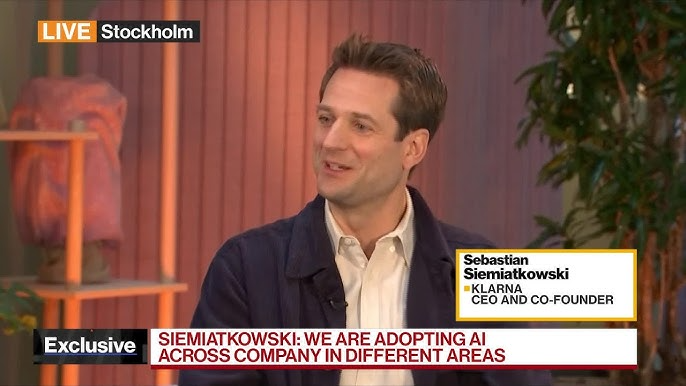
Klarna is the cautionary tale, and it deserves to be told every time this conversation comes up. In 2023, they removed 700 customer service staff, replaced them with a chatbot, and trumpeted savings to anyone who'd listen. By 2025, they were rehiring humans. CEO Sebastian Siemiatkowski admitted on record that "we went too far". Customer satisfaction had cratered. The bot couldn't do nuance or escalation, which turns out to be most of customer service.
Klarna isn't alone. Forrester's Predictions 2026 report reckons roughly half of all AI-attributed layoffs will quietly be reversed, often with rehires offshore or at lower wages. 55% of employers already regret the cuts. One in three has already spent more on restaffing than they saved.
This isn't a productivity story. It's labour repricing in a clever costume, and a lot of decent people are losing their jobs to a narrative.
What's going on with America?
Of the 11 countries surveyed, the United States ranks near the bottom for the percentage of organisations getting a great deal of value from AI. Thirty-eight percent. Germany, the UK, Japan, Australia, and the UAE all clock in above 50%. America is out-spending, out-hyping, and out-marketing the world. It's being out-delivered by half of it.
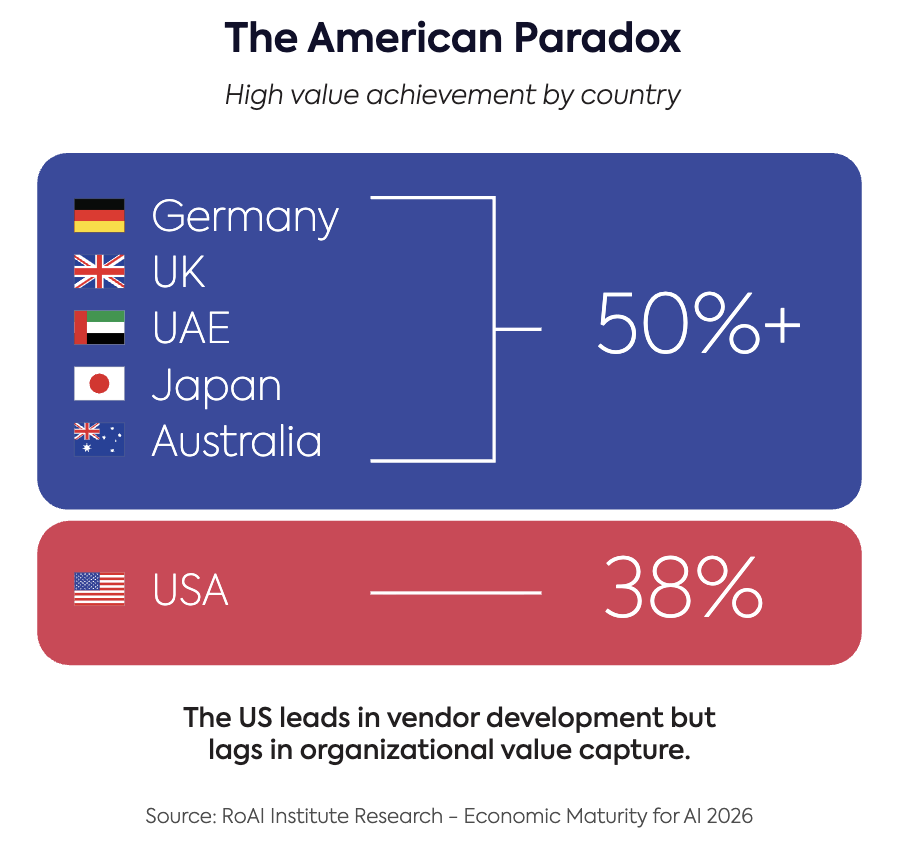
The authors politely call this the "American Paradox". I'd call it something less polite. The US is brilliant at producing AI vendors. Right now, it's mediocre at being an AI customer. Same gap we saw with electric vehicles and mobile payments. Build it. Don't use it well.
From where I work, across Australia, New Zealand, Singapore, and Philippines, the pattern is consistent. The organisations winning with AI are not the ones with the flashiest GenAI demos. They're the ones doing the dull, repetitive work. Measuring outcomes. Instrumenting use cases. Getting the CFO in the room. Reporting publicly.
DBS Bank in Singapore is the obvious benchmark. Roughly S$1 billion in economic value from AI and analytics in 2025, up from S$750 million the year before. They've been at this discipline since 2021, now scaled across more than 430 use cases. Each business unit's CFO validates AI value before it ladders up to a group number that goes in the annual report. None of that's an accident. It's six years of unfashionable measurement work compounding.

How do you get your organisation back on track?
First, stop pre-cooking the headcount cuts. If your AI isn't in production and isn't measured, you aren't capturing value through workforce reduction. You're sacking people on a hunch. The 2% versus 90% gap is the single biggest ethical and operational failure in enterprise AI right now. It'll also bite you, because Klarna isn't unique. Half the cuts will reverse.
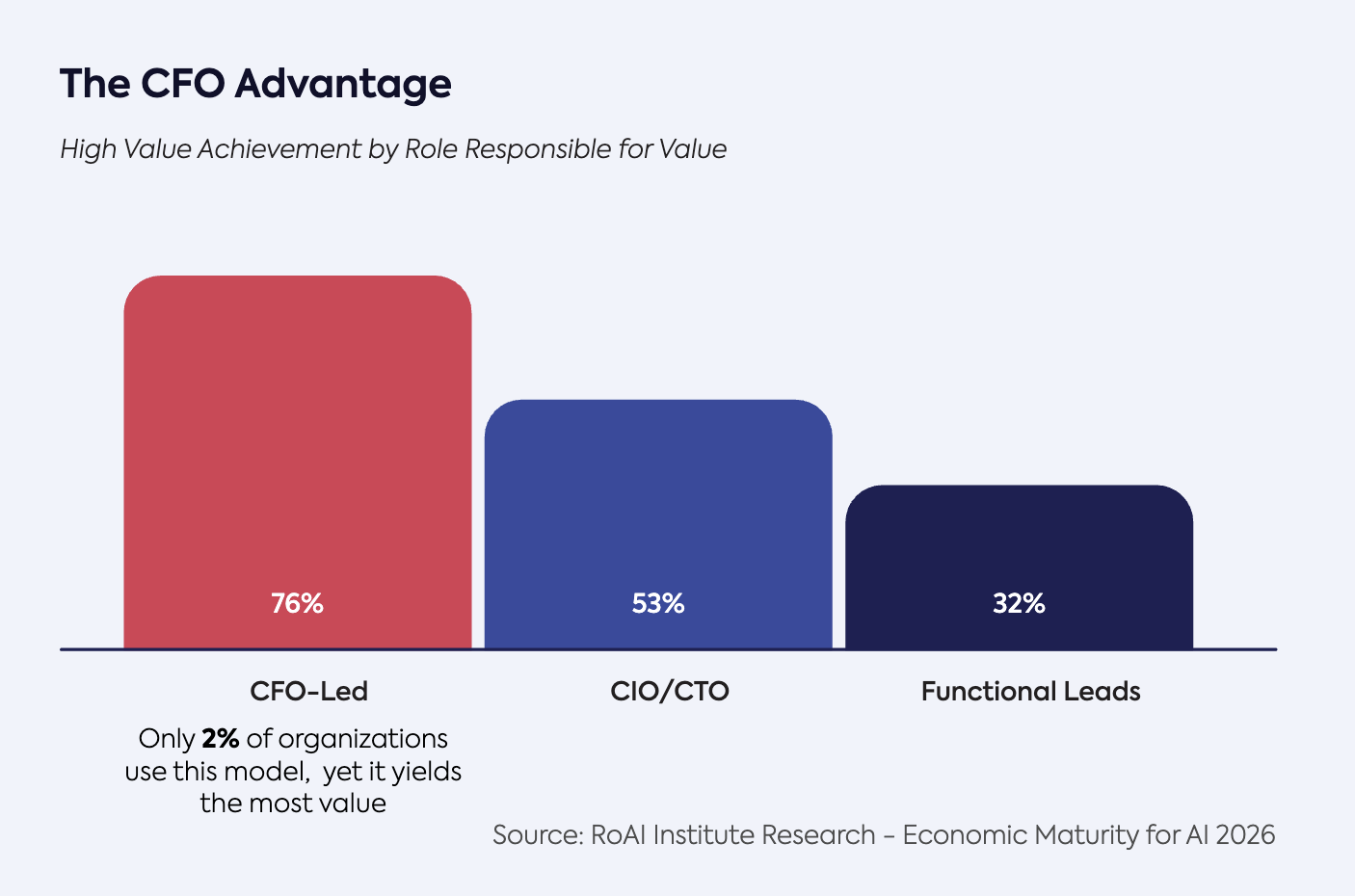
Second, hand the CFO the keys. The most striking number in the entire report: when CFOs own AI value, 76% of organisations report getting a great deal of value from it. CIO or CTO ownership produces 53%. Functional executives, 32%. And only 2% of companies actually use the CFO model. If you want one quick lever to pull this quarter, copy DBS. Make Finance certify each use case's value before it gets a budget.
Third, do the mixed approach, not one extreme. Companies running both broad and shallow (Copilot for everyone) and narrow and deep (custom solutions for real business problems) achieve high value 63.5% of the time. Either path on its own delivers a third of that. Picking one religion is a tax you pay for ideological tidiness.
Fourth, measure before and after. Thirty percent of organisations are stuck at Stage 3 of the maturity model for a median of six years. They measure use cases after deployment but never before. The jump from Stage 4 (aggregated, 58% high value) to Stage 5 (formal reporting, 85% high value) is the single largest inflection point in the whole model. Reporting forces discipline. Discipline produces value.
Fifth, treat AI as a product, not a project. A product owner. A baseline. A measurement plan. A business sponsor personally on the hook for adoption and benefit. The "deploy and walk away" project mindset is where AI value goes to quietly die in a SharePoint folder.
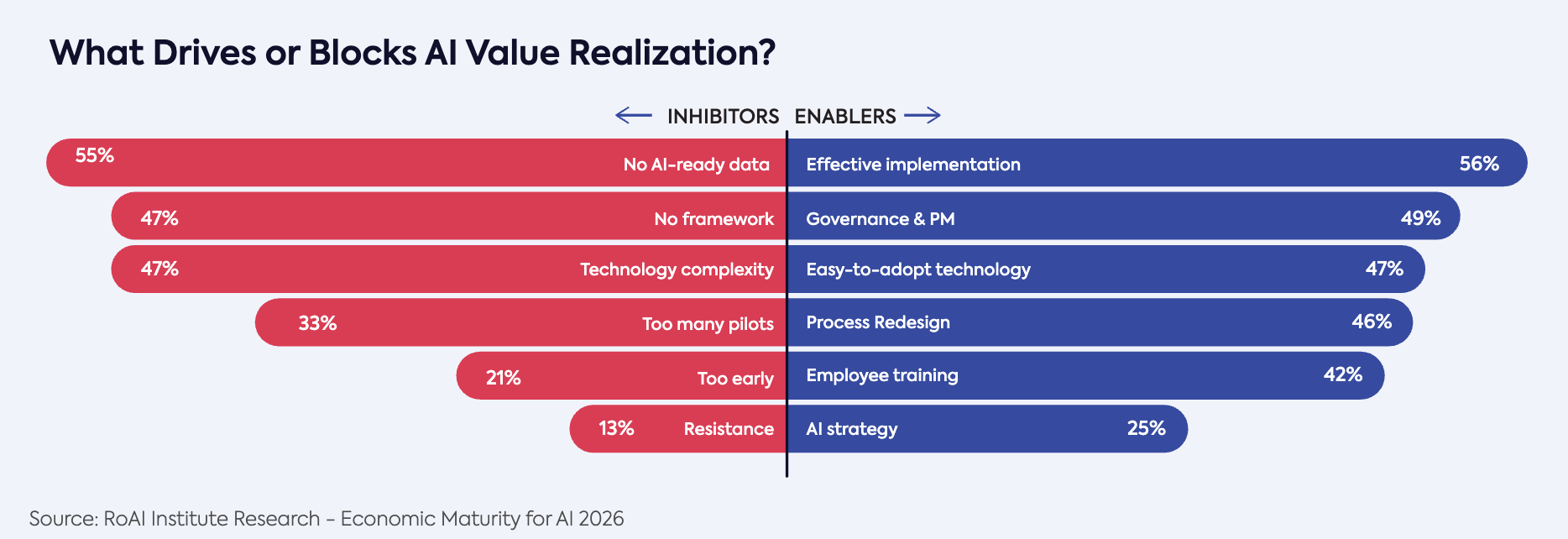
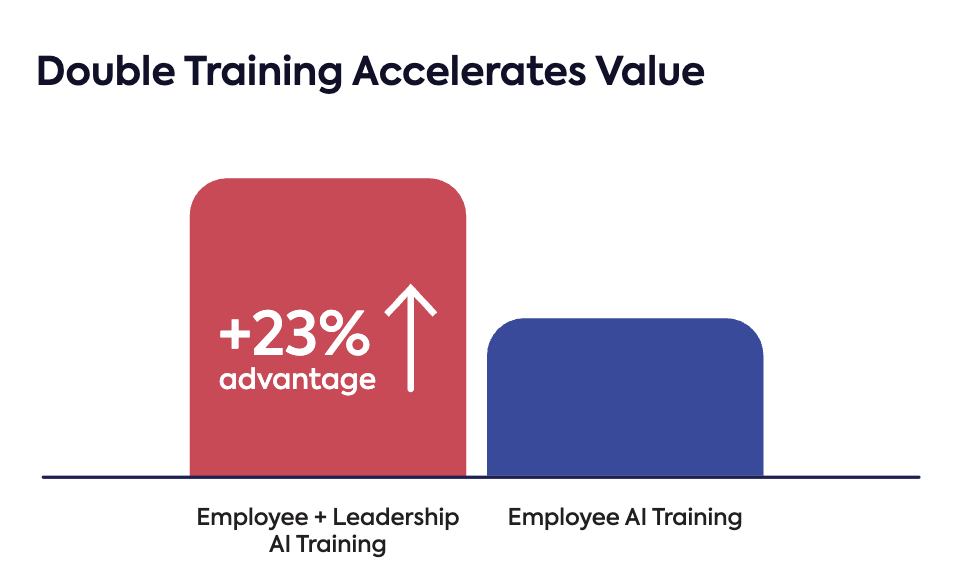
Sixth, train both ends of the org chart. 58% of organisations haven't trained employees on practical AI use. 29% admit leaders don't understand AI well enough to drive value. The orgs that fix both see a 23 percentage point uplift. Worth noting too, the least common inhibitor in the entire dataset is employee resistance, at 13%. Your people aren't the problem. Your leadership fluency is.
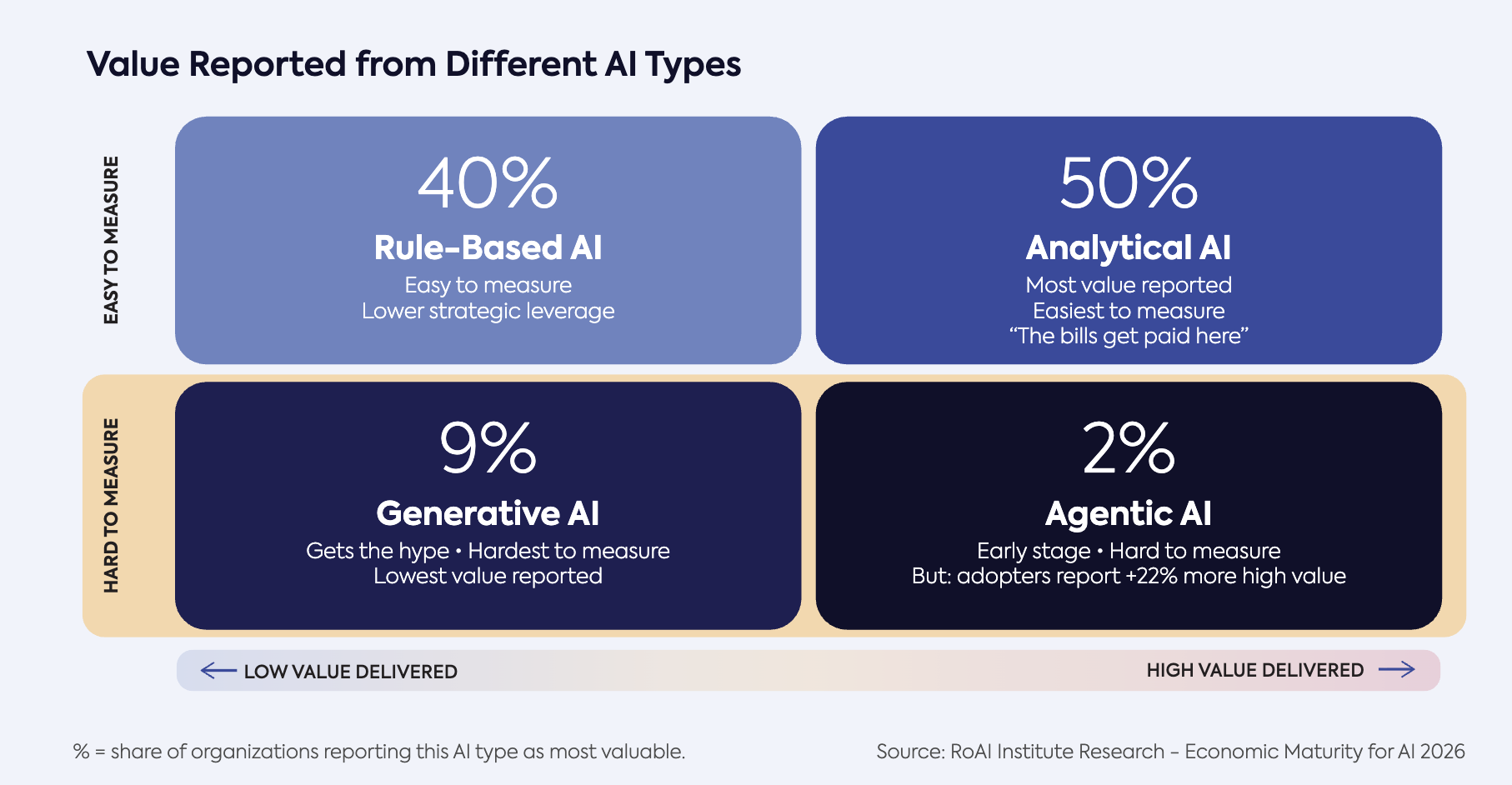
Seventh, be honest about which AI is actually paying the bills. Analytical AI, the boring old regression-and-prediction stuff, is the value champion at 50%. Rule-based automation is second at 40%. Generative AI gets all the hype and the lowest value rating, with only 9% of organisations saying it's their most valuable type. Agentic AI is early but interesting, with adopters reporting 22% more high-value outcomes. Don't pour your entire budget into the thing on the cover of the in-flight magazine.
Last, be patient. The five-year-plus AI veterans hit 52% high value. The zero-to-two-year cohort hits 12%. There's no hack. There's only the work, done over time, by people who get bored and keep going anyway.
Bottom line for enterprise leaders
APAC is demonstrably ahead of the United States on AI value capture. Don't squander it by importing American mistakes. The headcount-on-a-hunch reflex. The GenAI-because-the-CEO-saw-a-keynote obsession. The pilot-and-forget mentality.
Build value the way the bank up the road is building it. In production, with the CFO in the room, measured, reported, and patient enough to let the compounding actually happen.
The companies that win the next five years won't be the ones bragging about how many people they let go. They'll be the ones that moved the P&L, and had the receipts to prove it.
Has your organisation cut roles in anticipation of AI it hasn't yet deployed? And if so, do you regret it yet? Drop your thoughts in the comments. I read every one.
---
Robin Leonard is a Partner at Xenai Digital, an APAC enterprise Salesforce and AI consultancy. Two decades leading enterprise transformations across Australia, New Zealand, Singapore, Japan, and the broader Pacific. linkedin.com/in/robinleonard1
