

I asked him to show me. It was, genuinely, not bad. A clean React frontend, a Postgres backend, OAuth working, opportunity records flowing. Then I asked him three questions and watched the air slowly leave his face. Who is on call when this breaks at 2am on Boxing Day? Where is the SOC 2 report you give to the bank when they audit your supplier risk? What happens when the kid leaves to go work for Atlassian?
This is the Build vs Buy conversation in 2026, and it is genuinely the hardest version of it I have ever seen. AI agents now write production grade code at speeds that would have seemed laughable two years ago. The "buy" side is no longer a flat per seat fee either, every SaaS vendor on earth is quietly switching to consumption pricing for their AI features. And every executive I talk to in APAC has the same gnawing question: do I still need to be writing big cheques to Salesforce, Microsoft, Workday, ServiceNow, when my own people can build the thing in a fortnight?
Let me try to make the honest case for both sides. I should declare my hand up front. I am a Salesforce Consulting Partner. I get paid when people buy Salesforce. Take everything below with that in mind, and then notice that I am about to argue something different than you might expect.
The seductive pitch for build
Retool's 2026 Build vs Buy report found that 35 percent of enterprises have already replaced at least one SaaS tool with custom software, and 78 percent expect to build more in 2026 (Retool). The cost gap looks absurd on paper. In their example, a custom CRM that would have cost $80,000 to build in 2023 can be built in two days with the right AI tooling today. For a fifteen person team, three years of Salesforce Sales Cloud is around $100,000 versus six hundred bucks for the custom build. A 1,515x difference.
Andrej Karpathy's term "vibe coding," coined in early 2025, became a meme for a reason. People are doing this. Operations leads who could not write a for loop a year ago are shipping internal tools that genuinely work. The seduction is real, and dismissing it is a mistake.
The dirty secret of build
Then you read the data on what happens next. METR ran a controlled trial of experienced open source developers using AI coding agents in 2025. The developers felt they were 20 percent faster. They were measured to be 19 percent slower (METR). A forty percentage point gap between what people feel and what is actually happening, which should make anyone making a Build decision very nervous about how confident they feel.
Forrester now predicts that technical debt for 75 percent of companies will rise to "moderate" or "high" severity in 2026, directly attributable to unstructured AI code generation (Armorcode summary). Gartner is harsher. They forecast that by 2028, prompt to app approaches adopted by citizen developers will increase software defects by 2,500 percent (Gartner via Armorcode). Karpathy himself, the bloke who coined "vibe coding," walked it back this year and renamed the future of the discipline "agentic engineering" (The New Stack). The whole point of the rename was that the vibes need a grown up in the room.

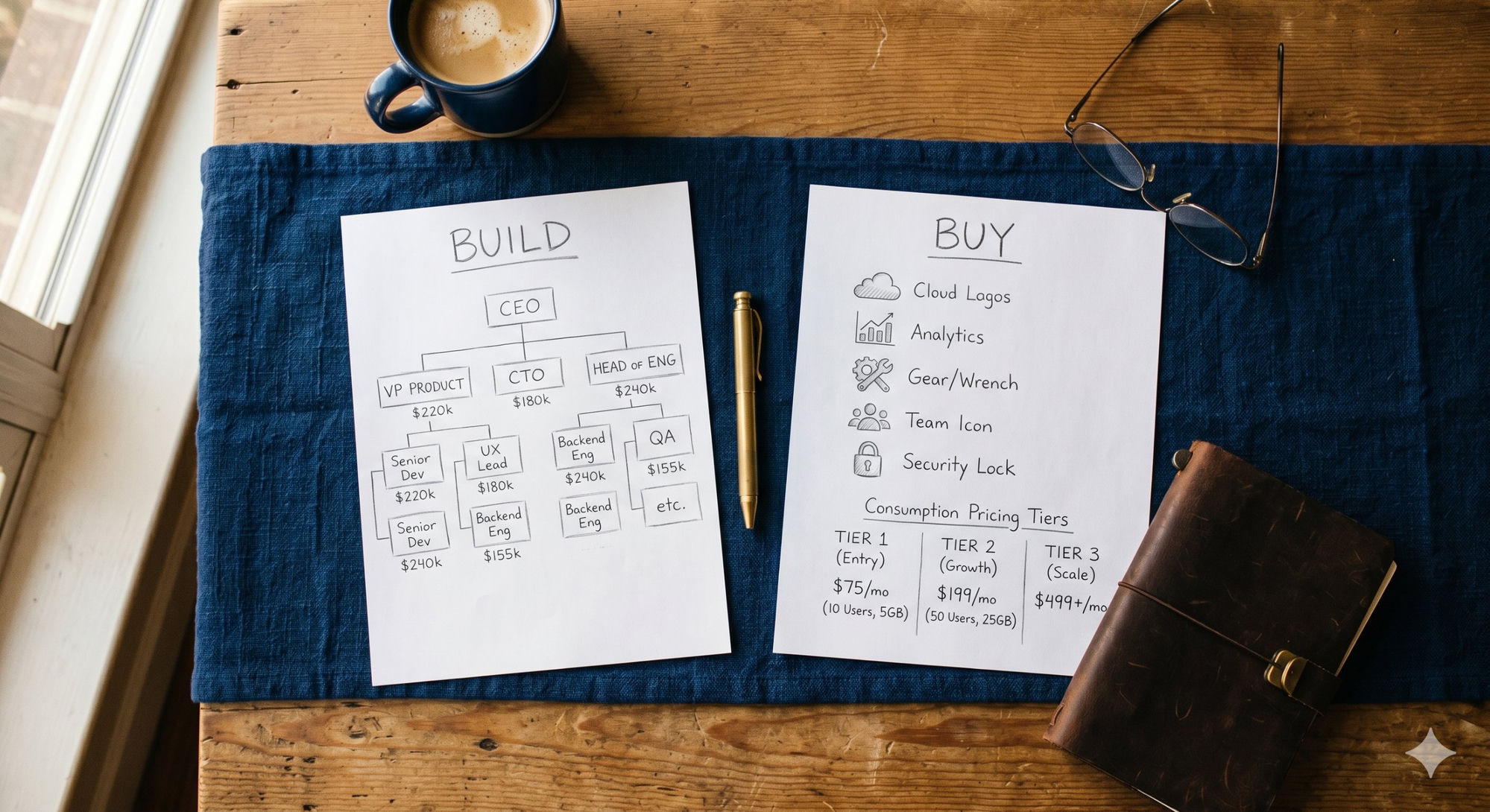
Now the costs. To build and maintain a serious internal application stack in Sydney in 2026, you need, at a minimum, two senior engineers (around $180k each), a solution architect (around $220k), a DevOps engineer (around $150k), a security engineer (around $170k), and a product manager or business analyst (around $140k) (Hays Australia salary guide, Robert Half DevOps Sydney). That is roughly $1.04 million in fully loaded base salary before super, tooling, cloud infrastructure, LLM API consumption, and the consultants you will hire when something genuinely breaks. Realistic all in is $1.2 to $1.4 million per year, per stack, and you are still not paying for the platform you replaced. You are paying for the team that replaced it.
The forgotten cost of buy
Here is where my own industry needs to stop pretending. Buying Salesforce or Microsoft is not a license fee. It never was. For every dollar you pay Salesforce, you typically pay somewhere between 50 cents and four dollars to a partner like mine, plus an internal team to actually run the thing. A 200 seat Salesforce org needs 1-2x Admins, a BA, and access to an Architect. Call it $350,000 a year in salaries before the platform fee or partner spend.
And the platform fee itself is rapidly stopping being a flat fee. Salesforce Agentforce now charges ~$0.40 for your average conversation (Salesforce Agentforce pricing). Microsoft 365 Copilot is $30 per user per month, with custom agents through Copilot Studio at $0.01 per message and credit packs starting at $200 a month for 25,000 messages (Microsoft 365 Copilot Enterprise pricing). Microsoft's new Agent 365 governance layer is another $15 per user per month. Gartner predicts 40 percent of enterprises using consumption priced AI coding tools will face unplanned costs exceeding twice their expected budgets by 2027. The Buy line item is becoming a seat + metered utility, and the meter is faster than you think.
A worked example for a 200 person APAC business
For a mid market Australian business with 200 users, the honest comparison looks roughly like this on an annual basis.
The Buy path, Salesforce Enterprise with Agentforce, lands around $720,000 in platform fees, $370,000 in internal admin team, $250,000 in partner spend, and an unpredictable $50,000 to $200,000 in AI consumption. Call it $1.4 to $1.6 million.
The Build path, equivalent internal CRM and workflow stack, lands around $1.04 million in salaries, $50,000 in tooling, $100,000 in cloud and LLM consumption, and a contingency I would price at $150,000 because something will go wrong. Call it $1.3 to $1.5 million.
They are within a hair of each other. Anyone selling you a 20x cost saving is showing you a fifteen person company's CRM, not a 200 person company's CRM with integrations, audit, security, change management, and a 24/7 support obligation.
Some systems are easier to replace than others
The honest truth is that this is not one decision, it is many. Internal admin tools, dashboards, light workflow automations, simple BI: these are increasingly fair game. Retool's data shows that is exactly where replacement is happening, with workflow automations at 35 percent and internal admin tools at 33 percent of replacements (Retool 2026 report). Where Buy still wins, and may win for a long time, is anything with deep regulatory exposure (financial reporting, HR records, anything an auditor will sit across from you about), anything with massive ecosystem leverage (the 7,000 plus AppExchange apps you would have to rebuild), and anything where vendor accountability genuinely matters when something goes wrong at 3am on a public holiday.
Will AI change this calculus?
Yes, but not in the direction the cheerleaders think. AI is making the Buy side cheaper too. Agentforce, Copilot, Monday - every platform now has an AI layer that automates the customisation work consultancies like mine used to charge for. The gap between Build and Buy is narrowing from both sides. The decision is going to be less about cost and more about three things: the risk appetite of your board, the calibre of your internal engineering culture, and whether the system you are replacing is a system of record (hard to replace) or a system of work (much easier).

Bottom line for APAC enterprise leaders
Do not vibe code your CRM. Seriously, please do not. Do consider building your own internal tooling, dashboards, and workflow apps where the regulatory exposure is low and the integration depth is shallow. Treat the consumption pricing on your SaaS contracts as a serious financial risk to model, because by next year it will be a board level conversation. And recognise that the people who can actually pull this off are not the kid from uni with Cursor. They are senior engineers, with senior architects above them, working to a real spec.
References
- Retool's 2026 Build vs. Buy Report: 35% of Enterprises Have Already Replaced SaaS With Custom Software — BusinessWire
- Retool: The Build vs. Buy Shift, AI, Shadow IT, and the SaaS Replacement Era
- METR: Measuring the Impact of Early-2025 AI on Experienced Open-Source Developer Productivity
- METR: Updated Developer Productivity Experiment Design (Feb 2026)
- The New Stack: Vibe coding is passé. Karpathy has a new name for the future of software
- Forrester / Armorcode: Your GenAI Code Debt is Coming Due
- Gartner Predicts 2026: AI Potential and Risks Emerge in Software Engineering Technologies
- Salesforce Agentforce Pricing
- Microsoft 365 Copilot Enterprise Pricing
- Hays Australia: Software Engineer Salary Guide
- Robert Half: DevOps Engineer Salary Sydney 2026
---
Robin Leonard is a Partner at Xenai Digital, an APAC enterprise Salesforce and AI consultancy. Two decades leading enterprise transformations across Australia, New Zealand, Singapore, Japan, and the broader Pacific. Splits his time between Auckland, Sydney and Tokyo, and rides a Royal Enfield Himalayan 450 when the weather agrees with him. linkedin.com/in/robinleonard1
