

If you've been anywhere near the Salesforce analytics conversation in the last eighteen months, you've probably heard the rumour: "CRM Analytics is dead." "Tableau Next is coming for it." "Don't buy it, you'll be migrating in a year."
It's a great story. It's also wrong.
So let's clear the air. CRM Analytics, or CRM-A as everyone calls it, is not being sunsetted (yet). Salesforce has publicly committed to a "robust product roadmap" alongside Tableau Cloud, Tableau Server, and the shiny new Tableau Next. The Winter '26 and Spring '26 releases shipped genuinely useful CRM-A enhancements, from Snowflake VPC output to reference lines in Lightning Dashboard Charts. Engineers are still engineering. The product is still evolving.
But the question on every BI manager's lips: if Tableau Next is the future, what the hell is CRM-A for now?
That's the article. Grab a coffee.

A quick catch-up on what CRM-A actually is
For anyone who just got handed the Salesforce portfolio and is drinking from the firehose, let's rewind.
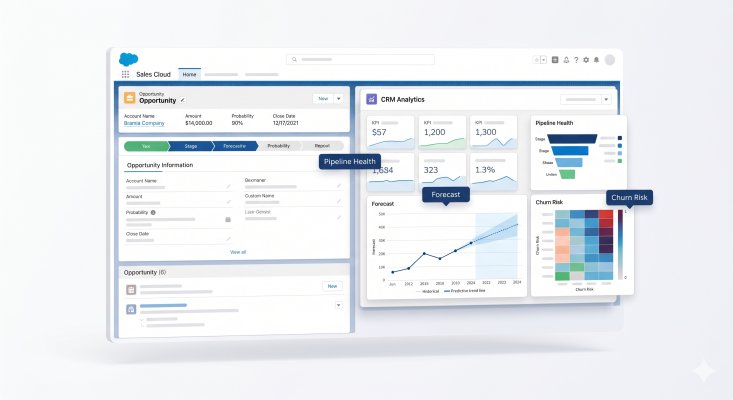
CRM Analytics, aka Tableau CRM (TCRM), aka Einstein Analytics, aka Wave Analytics (yes, four names in the last 12 years — Salesforce just loves a rebrand), is the native business intelligence platform that lives inside your Salesforce org. It's the thing that lets you do serious analytics without melting your CRM.
Here's the clever bit. Standard Salesforce Reports and Dashboards run directly against your live CRM data. That's fine for "how many opportunities did I close last quarter", but it falls the moment you try to crunch ten million rows, pull in ERP data, or run a machine learning model across five years of customer behaviour. CRM-A solves that by holding its own data layer separately from core Salesforce, so it can grind through massive datasets and throw sophisticated analytics back into the Salesforce UI without making your org cry.
In practical terms, CRM-A gives you big data processing without hammering Salesforce governor limits. It offers predictive models powered by Einstein AI: churn prediction, sales forecasting, demand modelling. It integrates with non-Salesforce systems like ERPs, eCommerce platforms, marketing automation, and POS tools. Dashboards are real-time, role-tailored, and sit beautifully inside Salesforce CRM Page Layouts. And it's all drag-and-drop that us non-technical users can operate without needing a data science degree.
The selling point has never been "prettier charts than Tableau". It's analytics in the flow of work. Insights displayed where your team is working, with CRM security, sharing rules, and field-level permissions baked in from the start.
So why did everyone think it was dying?
Because in October 2024, Tableau CEO Ryan Aytay sat down with Salesforce Ben and said things like this:
"One of the downsides with CRM-A is that you can't click into the visualisations and deep dive like you can with Tableau. Our plan has been to take the front end of the user experience and pair it with Tableau's exploration capabilities. The combination means that we can feed these rich analytics into Sales Cloud, Service Cloud. Over time, this will become the new CRM-A."
The phrase "legacy product" was used. The phrase "this will become the new CRM-A" was used. Consultants read that, reached for their LinkedIn posts, and declared CRM-A officially on life support. Customers who'd just spent a fortune on CRM-A implementations got twitchy. Procurement teams froze deals. Analytics leaders started getting pulled into "urgent" meetings about migration paths that didn't exist.
Naming note (1 September 2026): the "Einstein 1" licences mentioned here were subsequently renamed Agentforce 1 editions — same bundle, new name, as the upgrade path below reflects.
For several of my customers, they had just upgraded to Einstein 1 licenses a few months earlier, which include CRM-A bundled, with no option to unbundle it. My customers were faced with the uncomfortable decision between three bad options:
Continue to build in CRM-A knowing that it may soon become technical debt
Upgrade to Agentforce 1 (which comes with Tableau Next)
Continue to use standard Reports and Dashboards
Then Tableau Next was officially revealed in March 2025, and Salesforce walked it back. Or more accurately, they added nuance. From the Tableau Next launch messaging, direct quote:
“Salesforce says it has robust product roadmaps for Tableau Cloud, Tableau Server, CRM Analytics, and any other analytics solution from Salesforce, so you and your analytics assets are in good hands and will continue to be invested in.”
Translation: we are not killing anything. Promise.
And they've backed it up. Interoperability across Tableau Next, Tableau Cloud, Tableau Server, and CRM-A is now a stated product principle. You can build agentic experiences in Tableau Next using data from CRM-A. Winter '26 shipped new CRM-A features. Spring '26 shipped more. The development team is still very much employed.
So is CRM-A dying? No. Is it the platform Salesforce is betting its next decade on? Also no. It sits somewhere in between, which is actually where most enterprise tech lives, despite what LinkedIn thought leaders would have you believe.
The real question: where does CRM-A fit alongside Tableau Cloud and Tableau Next?
This is the conversation worth having. Here's how I'd break it down for a client today.
CRM Analytics is the right call when the job is deeply Salesforce-shaped. You want dashboards embedded directly inside Sales or Service. You care about inheriting CRM security and sharing rules without rebuilding them somewhere else. You want predictive analytics (churn, forecast, next-best-action) wired into the flow of work. You're not trying to be the BI platform for finance, HR, and supply chain. CRM-A shines when it's doing what it was designed to do, which is make Salesforce users smarter without dragging them out of Salesforce page layouts.
Tableau Cloud and Tableau Server are the right call when analytics is an enterprise-wide capability, not a Salesforce feature. You've got data scattered across five warehouses, ten SaaS tools, and a data lake. You've got a BI team who live and breathe visual analysis. You need power users building genuinely complex explorations with the full Tableau experience: drag-and-drop visual analytics, calculations, LOD (Level of Detail) expressions, the works. Tableau Cloud hosts this on the web. Tableau Server hosts it on your own infrastructure, which still matters to a surprising number of regulated industries and government customers, particularly in APAC.
Tableau Next is the right call when you're building for the agentic era. Tableau Next is Salesforce-platform-native, runs on Hyperforce, uses Data Cloud as the data layer, and has Agentforce stitched directly into the experience. It ships with pre-built analytics skills like Data Pro (data prep), Concierge (natural-language Q&A with root cause suggestions and recommended actions), and Inspector (real-time anomaly detection). This is where Salesforce is pouring its generative AI investment. If "let me ask a question in plain English and have an AI agent dig through the data and actually do something about it" is your vibe, Tableau Next is the future.
The key word Salesforce is now using, and it's worth clinging to, is interoperability. You can run all four. You can start in CRM-A, extend into Tableau, and layer Tableau Next on top as your AI maturity grows. That is the actual strategy. Not "migrate by Q3." Not "rip and replace."
"Organisations that have built on CRM Analytics have solved real-world problems, and it is essential that those investments are protected and evolved. The CRMA roadmap remains robust, signalling a clear trajectory toward interoperability with Tableau Next, Data 360, and the emerging Agentic AI landscape." — Mark Tossell

Should you still invest in CRM-A right now?
Short answer: yes, if you fit the CRM-A profile.
Longer answer: if your use case is embedded Salesforce analytics with predictive capability and you're getting value today, keep building. The roadmap is alive. Winter '26 and Spring '26 both delivered meaningful improvements, including tighter Data Cloud integration, better live-data handling, and improved output pipelines to Snowflake. Revenue Intelligence and Service Intelligence, two of Salesforce's most strategic analytics offerings, are still powered by CRM-A under the hood. Salesforce isn't about to deprecate the engine running two of its own flagship verticals.
If your use case is actually "we want a proper enterprise BI platform that services every team", don't buy CRM-A. Buy Tableau. That was always the answer, even before Tableau Next existed.
If your use case is "we want to build agent-driven analytics experiences where users ask questions in natural language and agents take action", start scoping Tableau Next now. CRM-A can happily sit alongside it as the trusted data source for Salesforce-native workflows.
The only scenario where I'd pump the brakes is if you were about to kick off a massive, multi-million-dollar greenfield CRM-A implementation with zero existing investment in the platform. In that case, the honest conversation is: should this be Tableau Next instead? The answer depends on your Data Cloud maturity, your appetite for agentic AI, and whether your users actually need to live inside Salesforce to get value.
For most enterprises we work with at Xenai Digital, the answer is nuanced and specific to the organisation. There is no generic right answer, which is exactly why generic advice on LinkedIn should be treated with appropriate suspicion (including this article, if I'm being fair).
Quick word on data security, because the compliance folks keep asking
CRM-A inherits enterprise-grade security features out of the box. Role-based access control, data encryption at rest and in transit, full audit trails. It plays nicely with GDPR, HIPAA, CCPA, and the Australian Privacy Principles. It's been battle-tested against enterprise RFPs for years, including APAC-specific ones, and it holds up. Nothing to panic about.
Where I'd land
CRM Analytics is not dead. It was never dead. It had one nervous week in October 2024 when a CEO said something on the record that got read more aggressively than it was meant, and the market overreacted.
Here's the honest picture. CRM-A is a mature, actively-maintained embedded analytics platform that solves a specific problem brilliantly, and Salesforce has explicitly committed to investing in it. Tableau Cloud and Tableau Server are the enterprise BI stack for everything outside the Salesforce blast radius. Tableau Next is the agentic future for anyone ready to bet on it.
Pick the tool that fits the job. Run them side by side if you need to. Ignore anyone who tells you enterprise analytics has a single right answer, because they are either selling you something or they haven't actually done it at scale.
Data strategy is boring, patient work. That's why the good ones win.

---
Working on enterprise analytics strategy in APAC and trying to untangle a multi-product Salesforce stack? This is exactly the space Xenai Digital operates in. If you've got a Tableau Next conversation coming up and want someone in the room who has actually done it, drop me a line on LinkedIn.
Sources and further reading
- Salesforce Blog: The Agentic Enterprise starts with what you already have, October 2025
- Conversation With Tableau CEO: Moving on to Core, Agents, and Future of CRM Analytics, Salesforce Ben, October 2024
- Salesforce Reveals Tableau Next: Everything You Need to Know, Salesforce Ben, March 2025
- CRM Analytics for Salesforce CRM, Salesforce product page
- Tableau Next, Salesforce product page
- Salesforce Winter '26 Release Notes
- Salesforce Spring '26 Release Notes


