

I was in a tiny coffee shop in Melbourne last week, the kind where the bloke behind the counter treats a single pour-over like he is defusing a bomb. He asked what I did for a living. I gave him my usual line about being a Salesforce Consultant. He nodded politely, slid the cup across, and said, "Ah. So, a job the computer will do soon."
Cheers bro. Great coffee. Brutal read on my career.
The funny thing, is that he might be right, and he's in good company being unsure about the timing. A week or so ago I ran a poll on LinkedIn asking a deliberately uncomfortable question: how long until AI completely replaces your current job, meaning zero humans are needed to do it. Not "assists you". Not "changes your workflow". Gone. Nobody home.
What the poll actually said
The results split four ways:
- 10% said 0 to 2 years (by 2028). One in ten of you think your role is essentially on the clock right now.
- 21% said 3 to 5 years (by 2031). The biggest chunk of the "soon" camp.
- 11% said 6 to 10 years (by 2036). A slow burn, but a burn nonetheless.
- 58% said 11+ years, or never. The overwhelming majority planted a flag and said, not in my working life.
So roughly a third of respondents, 31% to be precise, believe their job is gone within five years. And almost six in ten think the whole thing is overblown, at least for them.
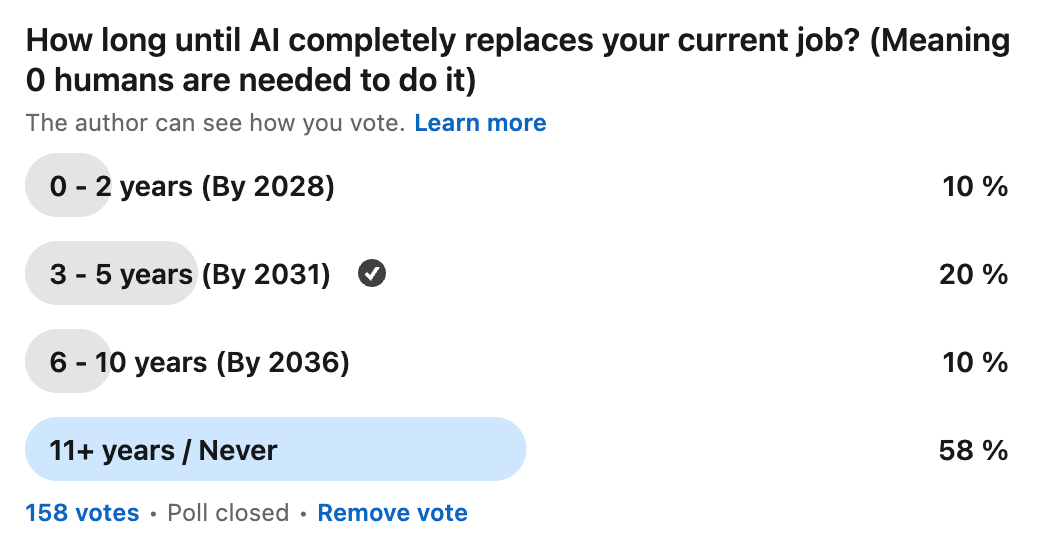
I will be honest. The 58% surprised me. Not because those people are dumb, they are clearly not, but because the gap between that number and what the people building this technology are saying out loud is enormous. Someone is going to be very wrong, and the stakes on being wrong are not small.
The people building it are not exactly reassuring
If you want a cold shower, spend an evening on YouTube with the folks closest to the machine.
Start with Geoffrey Hinton, the so-called Godfather of AI, on The Diary of a CEO (watch here). This is a man who won a Nobel Prize for the foundations of the technology, then quit Google so he could warn people about it without a press office hovering. His advice for the next generation? Become a plumber. He reckons:
“For mundane intellectual labour, AI is going to replace everybody.”
Then there is Dario Amodei, the CEO of Anthropic, who told Axios that AI could wipe out half of all entry-level white-collar jobs and push unemployment to 10 to 20% within one to five years (Axios coverage). He named names too: entry-level consultants, lawyers, and finance professionals. His line that stuck with me was that we, the producers of this technology, "have a duty and an obligation to be honest about what is coming," and that it simply is not on most people's radar.
If you want the properly vertigo-inducing version, watch the AI 2027 breakdown on the Dwarkesh Podcast with Daniel Kokotajlo and Scott Alexander (here). It is a month-by-month scenario for an intelligence explosion, read by over a million people including a sitting US Vice President. You do not have to buy every prediction to find it sobering.
And for the ground-level reality rather than the forecasts, there is the genuinely grim "How AI is Causing a White Collar Purge" (watch), which walks through a generation that was told a degree meant security, now watching those exact roles in finance, law, tech and consulting quietly evaporate.
But the 58% are not pulling their view out of thin air
Here is where it gets interesting, and why I do not think the majority are simply in denial.
The Economist made a proper, evidence-led case for the other side in "Why AI won't wipe out white-collar jobs" (watch). And the data backs some of it up. MIT Technology Review ran a reality check on the "AI jobs hysteria" and found that, as of now, the unemployment rate for the occupations most exposed to AI is actually lower than for less-exposed ones (read). MIT's David Autor points to government cuts and political turmoil as bigger drivers of recent layoffs than any robot.
Even Amodei has softened the drums. By mid-2026 he had shifted from "white-collar bloodbath" to talking about the Jevons Paradox, the idea that making something cheaper and more efficient can create more demand for it, not less (Fortune). The World Economic Forum still projects a net gain of jobs globally by 2030, even while 85 million roles get displaced.
So the optimists have receipts. The honest position is that nobody actually knows, and the forecasting community reflects that. Metaculus puts a 50% chance on AGI by 2033. Polymarket has it far lower. Take your pick of the betting markets and you can justify almost any timeline you like.
Why I'm in the 31%, not the 58%
Now my actual opinion, since I asked you for yours.
I think there is a real chance my own job is redundant within three to five years, and I am not being dramatic. AI can already provide strategy, advice, and solution architecture today, provided you know precisely what to ask it. The hard part of my work was never the typing. It was knowing the right question, the trade-offs, the war stories. A lot of that is now a very good prompt away.

What I keep coming back to is the moat, or rather, my lack of one. A doctor cannot be replaced by software tomorrow because the law says a human with a licence has to sign off. Same for a lawyer in court, an auditor on the accounts, a pilot in the cockpit. There is a legislative wall protecting those roles, built deliberately, that AI cannot simply walk through.
A consultant has no such wall. There is no Act of Parliament requiring a human to advise you on your Salesforce architecture. If an organisation can self-service strategy and design at a fraction of the cost and nearly the quality, the only thing left for me to sell is the relationship. The trust, the accountability, the "I will stake my name on this working". That might be enough. It might also be the consulting equivalent of being the bloke who still hand-cranks the car.
That is the uncomfortable bit nobody on the conference circuit says out loud. The roles most exposed are not the ones doing manual labour. They are the well-paid, degree-requiring, advice-giving desk jobs. The ones a lot of us spent twenty years climbing towards.
The bottom line for APAC enterprise leaders
If you are running a business, here is the practical takeaway. Do not get lost arguing about whether it is 2028 or 2038. That argument is a distraction. Instead:
- Find your moat and be ruthlessly honest about it. Is it regulation, relationships, proprietary data, or physical presence? If you cannot name it in one sentence, you do not have one yet.
- Assume the advice layer gets cheap. Strategy, analysis, first-draft architecture: price it like it is heading towards zero, because it is.
- Invest in the things AI is bad at. Accountability, judgement under ambiguity, earning trust with a nervous board. These compound.
- Stop hiring purely for tasks that are now prompts. Hire for the judgement that decides which prompt to run.

The 58% might well be proven right, and I would be delighted to be wrong about my own redundancy. But planning your career and your business on "never" feels a lot like the Melbourne barista betting the computer will never learn to pull a decent pour-over. Maybe. I would not wager the cafe on it.
So I will throw the question back to you, since the poll only let me ask it once. If your job really is in the 58% that is safe forever, what exactly is your moat? Name it in the comments. I am genuinely curious whether yours is stronger than mine.
References
- Geoffrey Hinton on The Diary of a CEO (YouTube)
- Why AI won't wipe out white-collar jobs, The Economist (YouTube)
- How AI is Causing a White Collar Purge (YouTube)
- AI 2027, Dwarkesh Podcast with Kokotajlo & Alexander (YouTube)
- How AI is Pushing Tech Workers to Blue-Collar Jobs (YouTube)
- AI jobs danger: Sleepwalking into a white-collar bloodbath, Axios
- Dario Amodei, Jevons Paradox, Fortune
- A reality check on the AI jobs hysteria, MIT Technology Review
- AI 2027 scenario (full report)
---
Robin Leonard is a Partner at Xenai Digital, an APAC enterprise Salesforce and AI consultancy. Two decades leading enterprise transformations across Australia, New Zealand, Singapore, Japan, and the broader Pacific. linkedin.com/in/robinleonard1
