

I was sitting on a high speed train near Tokyo a few weeks ago, half-watching a salaryman nod off into his own reflection, when my phone lit up with a Slack message from a client in Sydney. Just one line. "Have you seen what they did to Sales Cloud?"
I had. Salesforce had just casually rebranded Sales Cloud to Agentforce Sales, dropped a new scripting language, open-sourced a bunch of it, shoved AI voice into the contact centre, and rebuilt the whole agent authoring experience from scratch. A standard Spring release, in other words. Nothing to see here.
If you've been nodding along politely at Salesforce release announcements for the last few cycles, you'd be forgiven for thinking Spring '26 is more of the same marketing theatre. It isn't. After a year of helping enterprises across APAC actually ship Agentforce into production, I can tell you this release is the first one that feels like it was built by people who've tried to run an agent in anger and lived to tell the tale.
There's real substance here. There's also the usual vendor polish layered over some genuine limitations.
So grab a coffee. Let's walk through what Spring '26 actually shipped, what it means if you're trying to make Agentforce work in the real world, and where I think Salesforce still has homework to do.
First, the numbers Benioff can't stop posting about
Before we dive into features, it's worth grounding ourselves in why Salesforce is moving at this pace. As of their most recent earnings, Salesforce reported over 18,500 Agentforce deals with 9,500 paid customers, with Agentforce and Data 360 now running at around $1.4 billion in annual recurring revenue and 114% year-on-year growth. Marc Benioff, in his usual restrained way, posted on X that Agentforce had crossed 11.14 trillion tokens served.
Whether those are 18,500 genuinely-live-in-production deals or 18,500 pilots that might graduate one day is a question I'll leave for the analysts. My inbox suggests the real production number is smaller than the announcements imply. But momentum is momentum, and Salesforce is pouring engineering at this faster than I've seen them pour anything in fifteen years.
The Release Cadence and What Actually Landed
Spring '26 arrived in sandbox on January 9, with production instances upgraded in waves on January 16, February 13, and February 20 (Salesforce Ben, Salesforce Admins). If your org is still on the old Agent Builder, check your instance. You're likely already sitting on most of what I'm about to describe.
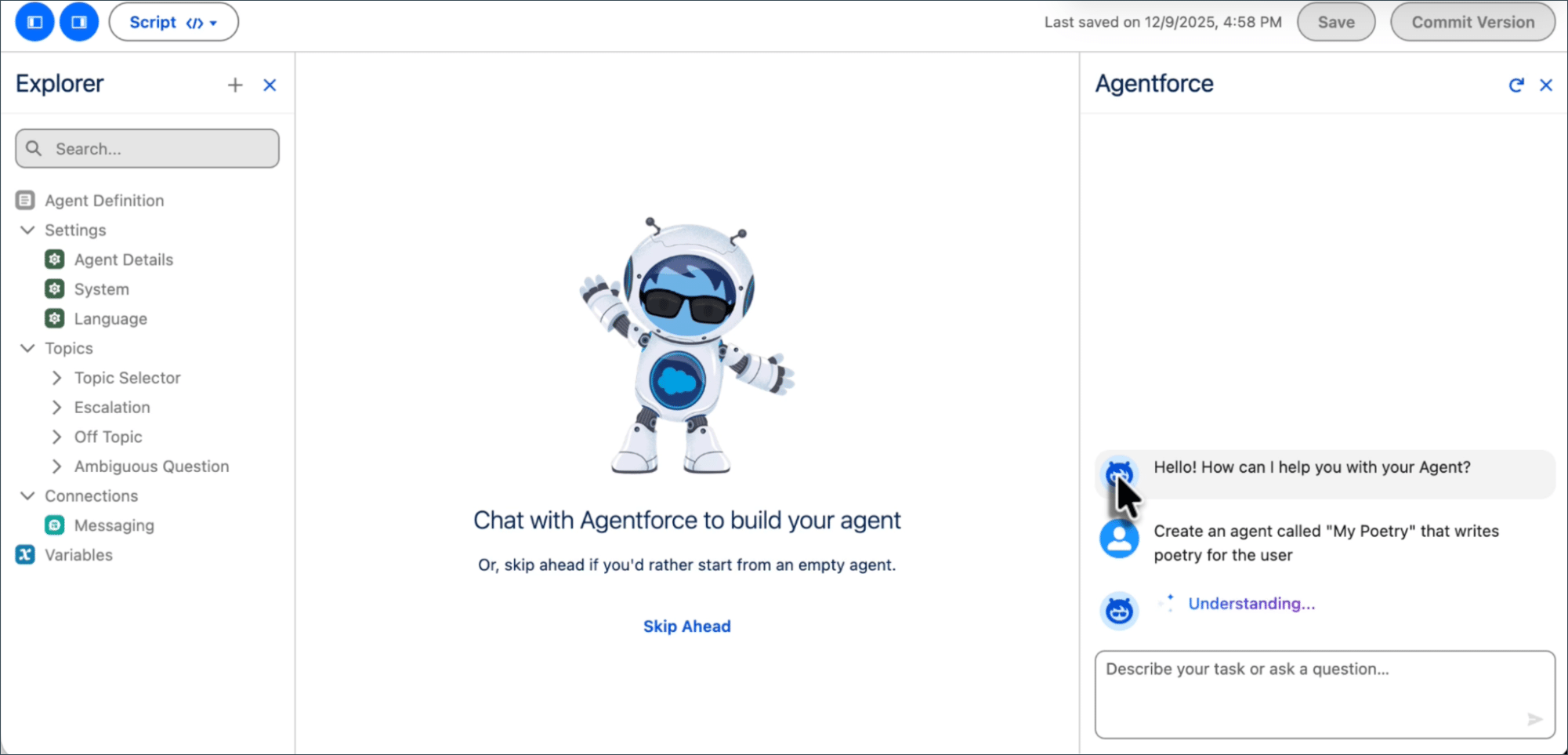
1. The New Agentforce Builder (Beta)
This is the marquee change. Salesforce has rebuilt the agent authoring experience from the ground up, and for once the marketing copy isn't lying. The new Agentforce Builder is genuinely better.
The Builder opens in Canvas view by default, which looks and feels like a visual flow for agent logic. You drag, connect, configure topics, set up escalation paths. If you've used Flow Builder, you already know half the gestures. Under the hood, the Canvas view is actually just a rendered summary of the new Agent Script language. You can expand any block to see the underlying script, and anything you edit in Script view reflects back into Canvas. It's genuinely bidirectional, which is not something I've ever been able to say honestly about a Salesforce builder before.
There's also a proper file explorer on the left, like you're in an IDE. Type / to drop in a pattern (if-else, loops, whatever). Type @ to reference a topic, variable, or action. Autocomplete is actually useful, which I say with genuine surprise because I've been burned by "AI-assisted" Salesforce tooling before.
The capability that matters most, and that people are massively underrating, is this: you can now mix deterministic logic and LLM reasoning in the same flow. That's the whole game. Deterministic logic runs top to bottom, every time, no surprises. LLM reasoning handles the bits where you actually need language understanding. You no longer have to choose between a brittle Flow that can't handle nuance and an over-eager agent that hallucinates its way through your business logic.
If that doesn't sound like a big deal, you haven't tried to explain to a regulated-industry compliance officer why your agent gave a different answer twice in a row.
2. Agent Script
Under the new Builder sits Agent Script, a proper scripting language purpose-built for defining agent behaviour. Salesforce has open sourced the specification, parser, linter, compiler, LSP, and editor integrations at github.com/salesforce/agentscript. That's not a marketing gesture. That's a real repo with real commits.
The syntax is pleasingly simple. You use | to indicate a line of prompt text that gets sent to the LLM. You use -> (or just :) to write procedural logic that executes deterministically. You wrap expressions in {! } to substitute variables into prompts. That's it. That's the whole trick.
Here's the shift in thinking. Every other agent framework I've deployed across APAC treats the prompt as the whole program. You write increasingly elaborate system prompts, you cross your fingers, you pray to the God of Attention Heads. Agent Script treats prompts as one tool among many. You can chain actions deterministically. You can enforce strict if/else conditional logic. You can control exactly what context gets passed to the LLM for each turn. It's what serious agent engineering has looked like at Anthropic and OpenAI for a while, now shrink-wrapped for enterprise Salesforce teams.
Adam Evans, SVP of Product at Salesforce, framed this well in a recent interview: "Just like 25 years ago with CRM, customers today don't want to build their own AI infrastructure. Instead of building a car by taking all the parts, customers want to take a Waymo and have their problem solved". Agent Script is the Waymo. Your job is to configure it, not to write the transmission.
3. Atlas Reasoning Engine
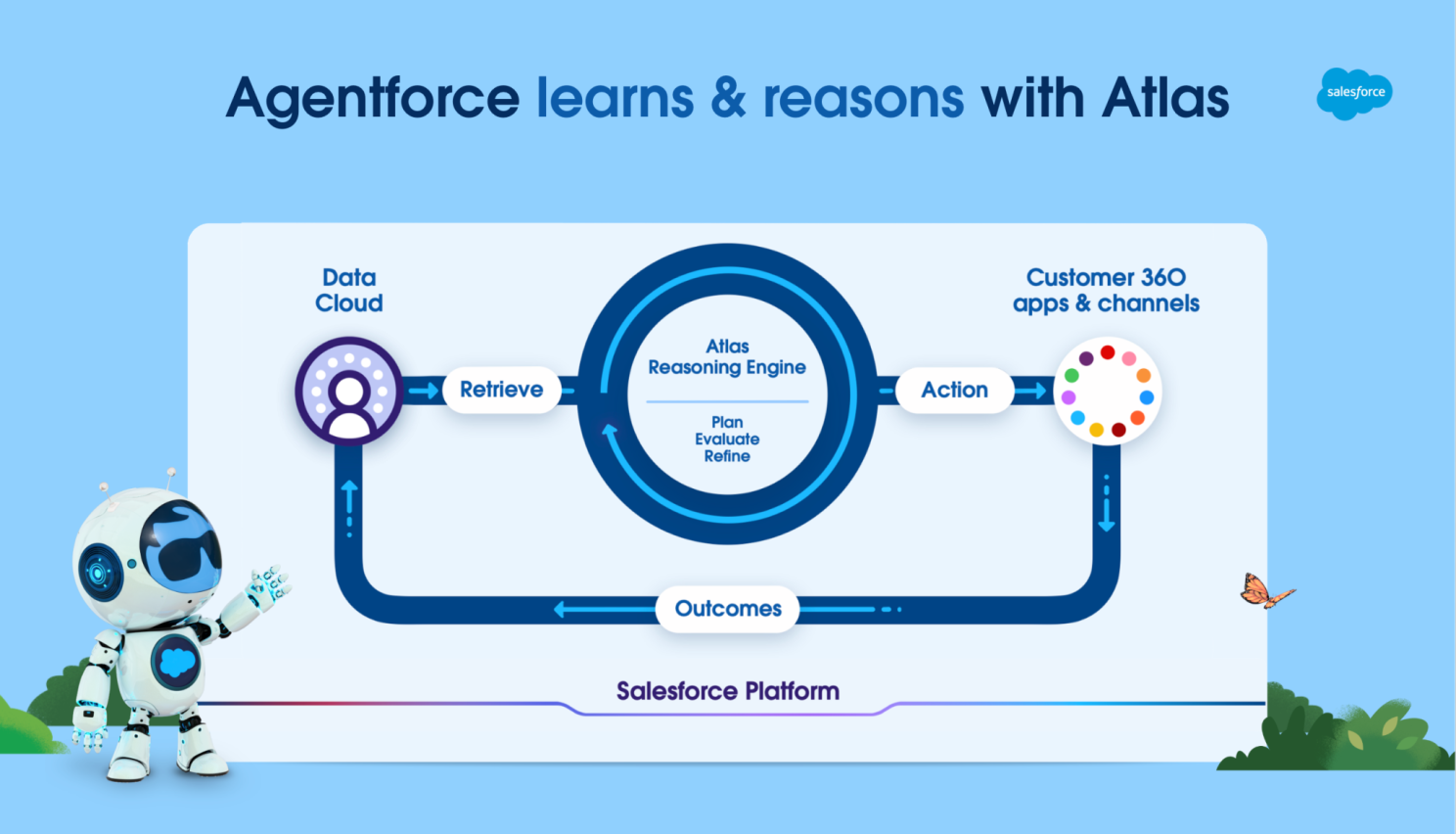
The Atlas Reasoning Engine is the part of Agentforce that most customers never see but entirely depend on. Think of it as the orchestration brain that decides what to do next, when to call a tool, when to ask for clarification, and when to give up and escalate.
Spring '26 ships an enhanced Atlas that is markedly better at what Salesforce calls "determining the job to be done." In practice, I've noticed two things running side by side with pre-release customers. First, the reasoning loops are measurably shorter. Atlas is less likely to go around in circles when an action returns unexpected data. Second, hallucination rates on knowledge retrieval have dropped noticeably when Data 360 is wired up properly. The official claim is that Atlas now implements "inference-time System 2 reasoning" to improve accuracy and lower hallucinations. That's corporate-speak for "it thinks before it speaks." Which, if you've ever watched an untuned agent cheerfully invent product SKUs, is not a small thing.
4. Agentforce DX for Developers
If you're a developer and you've been politely ignoring Agentforce because the clicks-not-code experience wasn't meeting your ergonomic needs, Spring '26 is for you. Agentforce DX is the pro-code equivalent of the Agentforce Builder UI, delivered as a VS Code extension and a Salesforce CLI plugin.
You can build, test, preview, and deploy agents entirely from your IDE. Agent configuration is now proper metadata, which means source control, CI/CD, code review, diffs, and all the other grown-up engineering practices your team was doing everywhere else and couldn't do for agents before. Previews use mocked LLM calls so you can test logic without lighting money on fire.
The thing I love most, and this is a small detail that matters enormously in practice, is that you can switch between Canvas, Script, and DX mid-build. Business analyst drafts the flow in Canvas. Developer opens it in VS Code to wire up the tricky conditional logic. Admin tweaks a topic back in Canvas. Same metadata, no exports, no reconciliation. If you've ever tried to keep Flow and Apex in sync on a complex automation, you'll understand why I'm as excited about this as I am.
5. Agentforce Voice
Agentforce Voice graduated to real-deal status in Spring '26. It's AI voice that plugs straight into Service Cloud and speaks in something that approximates natural human cadence. The important bit: it's designed to detect emotion, nuance, and intent, and hand off to a human when it's out of its depth, with full conversation history and customer context travelling with the handoff.
Integrations cover the obvious telephony suspects: Amazon Connect, Five9, NiCE, Vonage. Every call gets transcribed and logged automatically, which has the side-effect of turning your phone channel from a data black hole into searchable training data. For an industry that has historically treated the contact centre as a cost of doing business, that's a quiet revolution.
There's also Agentforce Voice for Financial Services, which is the same tech with the compliance guardrails that regulated industries require. Consent management, audit trails, controlled access to sensitive financial data, the lot. Banks I've spoken to in Sydney and Singapore are looking at this for collections calls and basic servicing first, which is exactly the right place to start. Boring, high-volume, auditable.
One honest caveat from the trenches: the emotion-detection is good, not magic. It picks up frustrated customers well. It still occasionally misreads Australian dry sarcasm as genuine contentment, which is a flaw you'll want to test for if your customer base is Australian.
6. Agentforce Sales (formerly Sales Cloud)
Salesforce has quietly rebranded Sales Cloud as Agentforce Sales. I say quietly because almost no one I've spoken to outside the Salesforce ecosystem has noticed, but I have a feeling this is going to cause a lot of internal arguments in sales operations teams over the next six months.
The real substance is the Prospecting Agent, which now runs 24/7. It enriches existing Salesforce data with signals from the web and external sources, researches accounts, builds a prioritised list of prospects, and delivers them inside Sales Cloud, Slack, ChatGPT, and Teams. Pair it with the Lead Nurturing agent and you've got a loop that keeps a prospect warm until a meeting is scheduled.
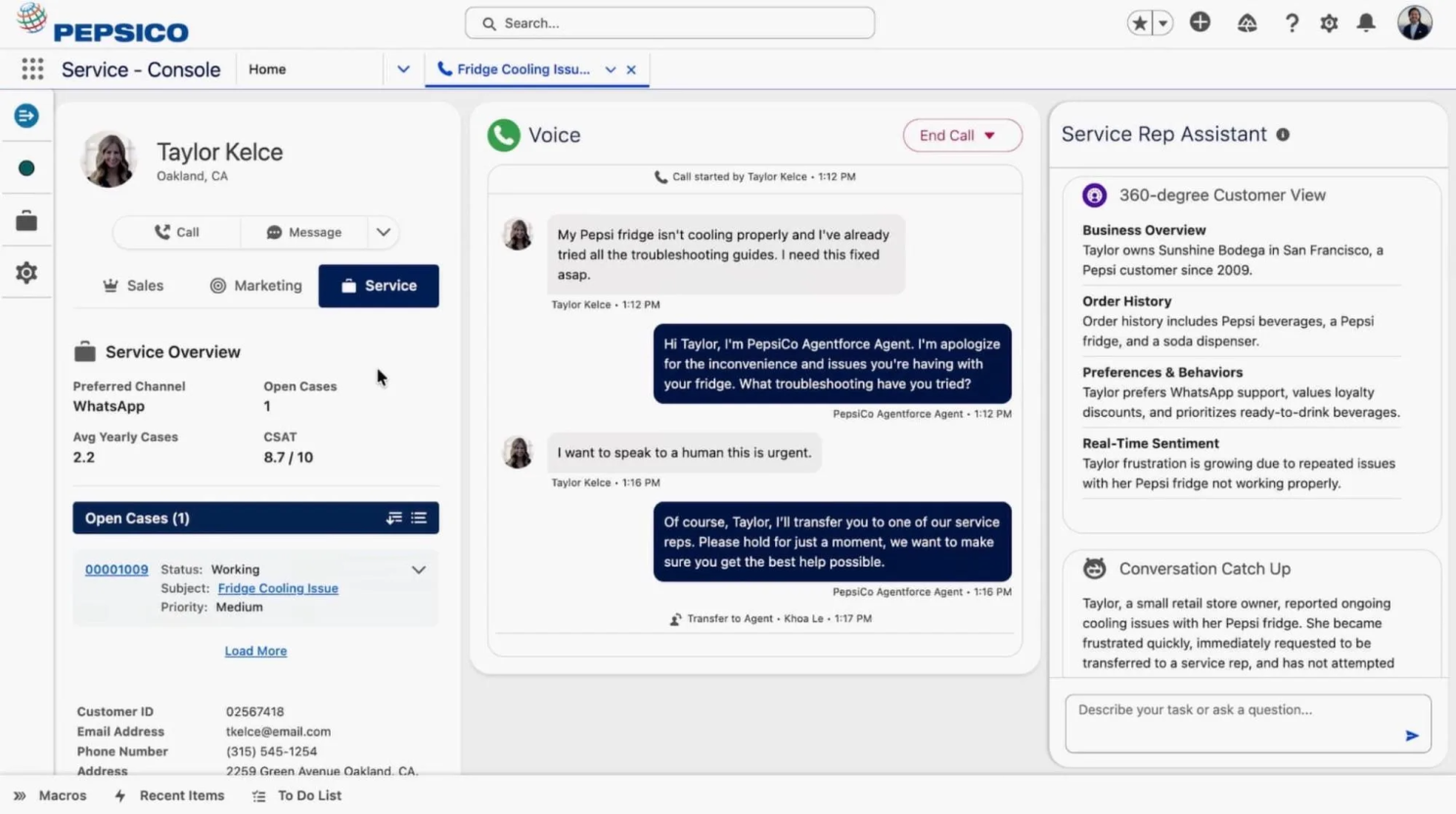
Here's the practitioner's honest take. This is the Agentforce use case with the shortest payback period in most organisations I work with. Sales reps genuinely hate account research. They'd rather be selling. An agent that does the prep and hands them a brief is a straight productivity win. The 200-400% ROI numbers Salesforce quotes aren't crazy if you actually measure against the SDR hours you displace.
The catch, and there's always a catch, is that your CRM data has to be good enough for the agent to build on. Garbage in, beautifully formatted garbage out. I'll save the data-quality sermon for another article, but if your account records are 60% complete you're not ready for this. Fix the foundation, then turn it on.
7. Agentforce HR Service and the Employee Agent
If you've been watching Salesforce's moves carefully, you'll have spotted that they have big plans for internal-facing agents, not just customer-facing ones. Spring '26 makes that plan tangible. Agentforce HR Service is an employee service solution with both an Employee Portal and an HR Service Console.
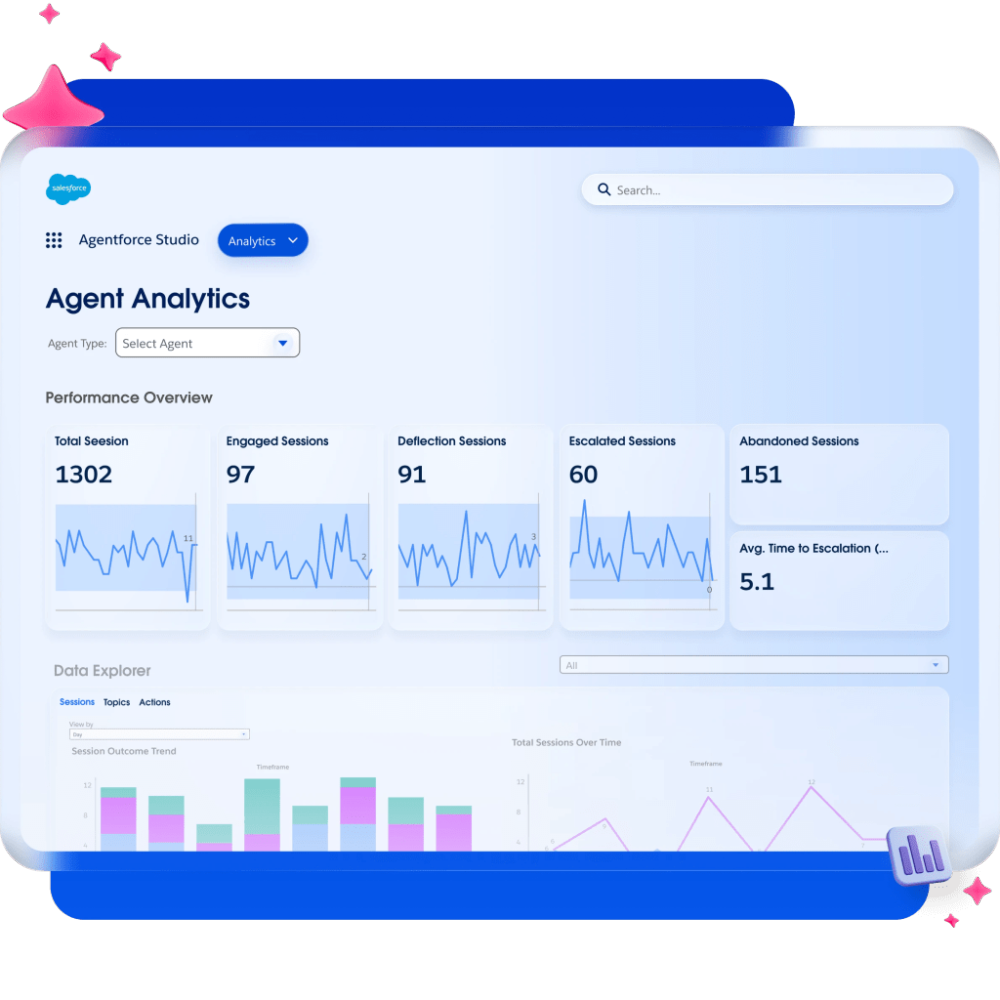
Salesforce's own HR team reports a 96% self-service resolution rate using it, which is a ridiculous number that I'd treat with a degree of healthy scepticism until I see it reproduced at a non-Salesforce customer. But even half that number is transformational for HR ops teams drowning in "how much leave do I have left" tickets.
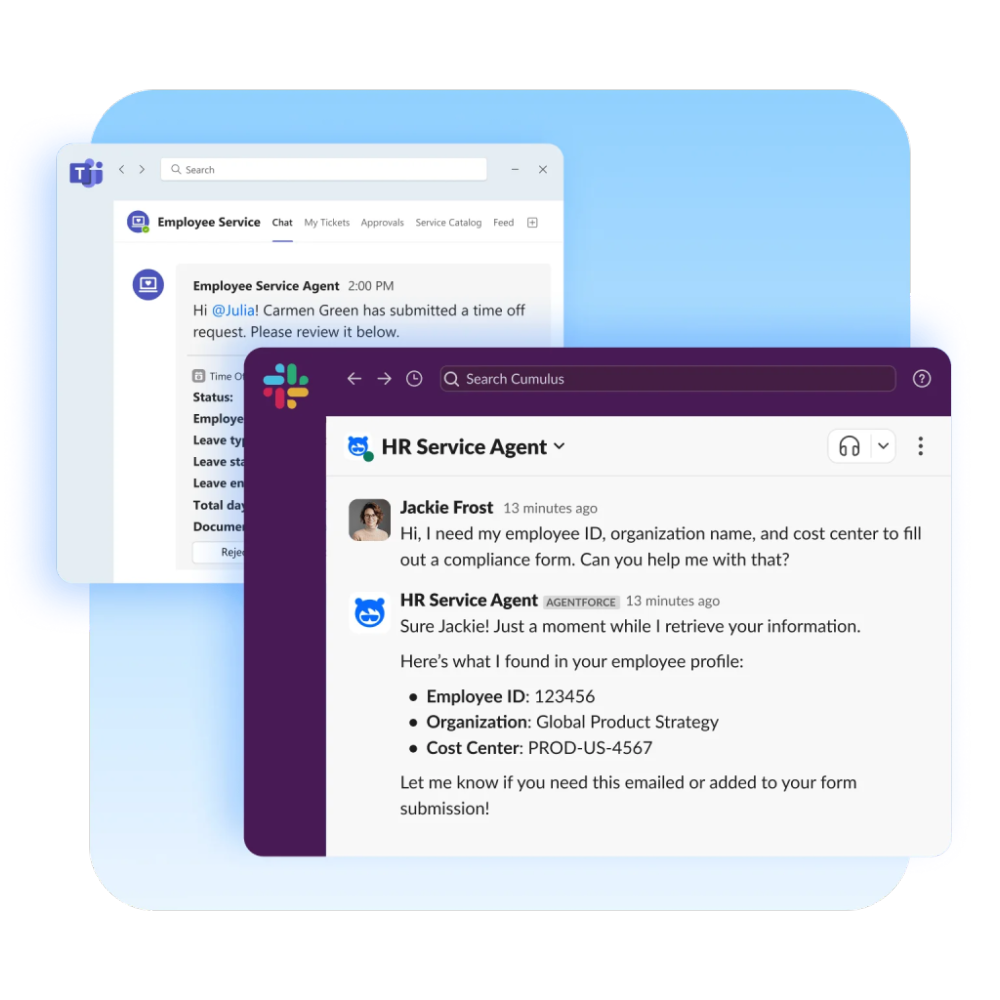
The key integration is Slack. Agentforce HR, IT, and Sales are all surfacing directly inside Slack, which is where your people already are. No portal to log into. No swivel-chair between six systems. Ask in the channel, get a response, carry on with your day. This is the "agentic enterprise" vision Benioff keeps talking about, finally made concrete.
The employee agents build inside the same new Agentforce Builder, which is a clever architectural decision. One tool, many use cases. Your admin team doesn't need to learn a separate HR builder and a separate IT builder and a separate service builder. It's all the same Canvas and Script. That consolidation alone saves enterprises a real amount of training and tooling cost.
8. Agentforce Command Center and Agent Analytics
This is the feature I have been begging Salesforce for since the day Agentforce launched. Command Center is a proper observability tool for AI agents.
You get aggregated performance metrics across every agent you've deployed. Error rates. Escalation frequency. Latency. Token consumption. Customer sentiment per conversation. You can drill into individual conversations, filter by intent, segment by sentiment, and pinpoint the topics where your agent is falling over. Agent Health Monitoring pushes near-real-time alerts when error, latency, or escalation rates spike.
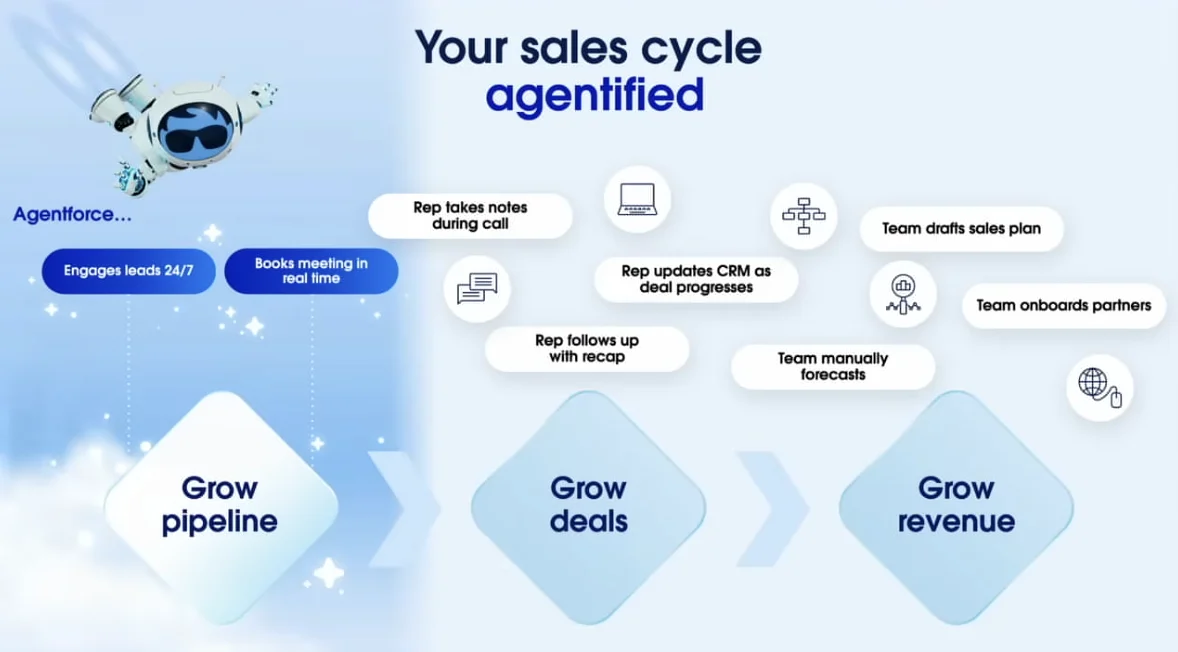
Why does this matter? Because the dirty secret of every pre-Spring '26 Agentforce deployment I've been near is that once the agent shipped, nobody really knew how it was doing. You had basic conversation counts. You maybe had CSAT scores. You definitely didn't have visibility into why the agent was escalating, which prompts were leaking context, or which data source was giving it bad information. Command Center finally closes that loop.
If you're already running Agentforce and you're not using Command Center yet, stop reading this article and go turn it on. Seriously. Come back when you've done it.
9. Agentic Enterprise Search (Preview)
This didn't GA in Spring '26, but it's worth flagging because it's where the platform is heading. Agentic Enterprise Search is designed to pull context from 200-plus external sources and coordinate action across multiple agents in a single search-like interface. Think of it as the universal entry point: you type a question, the system figures out which agents and data sources to orchestrate, and you get an answer and an action, not just a list of links.
It's still in preview, and preview in Salesforce-land can mean anything from "nearly ready" to "we're still figuring out what this is." I wouldn't plan your architecture around it yet. But I would keep an eye on it, because if they pull it off, the user experience of enterprise software changes shape.
10. Flex Credits pricing finally makes sense
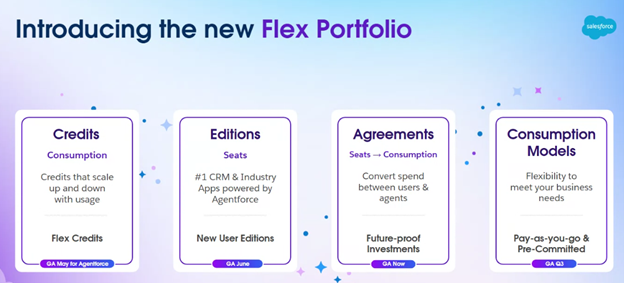
The pricing model that landed earlier in 2025 and matured through Spring '26 is the other quiet story of this release. Flex Credits replace the old $2-per-conversation model with something that scales across every Agentforce use case, not just customer-facing chat.
The numbers, if you haven't seen them: Flex Credits cost $500 per 100,000 credits. Standard actions consume 20 credits ($0.10). Voice actions consume 30 credits ($0.15). Conversations still exist as a flat-pricing option for predictable external customer-facing workloads.
In practice, for internal agents, data pipelines, and mixed workloads, Flex Credits are a significantly fairer model. You pay for what you actually use. Your CFO can forecast. Your procurement team can benchmark. I've seen multiple clients who were paralysed by the old model start pilots within weeks of Flex Credits arriving, because the unit economics finally line up with how they actually intended to use the platform.
What the Marketing Slides Won't Tell You
Here's the honest bit, because every good release analysis needs one.
First, the new Builder is in Beta for a reason. I've hit edge cases where Canvas and Script views fall out of sync on complex branching logic. Save, reopen, and the discrepancy resolves, but it'll rattle you the first time. This will settle down over the next few releases. For now, save frequently and keep your source control hygiene tight.
Second, the "96% self-service resolution" HR number should make your BS detector twitch. Salesforce's own HR team is probably the best-instrumented, best-data-quality-having, most-willing-to-use-agents workforce on the planet. Your mileage at a 5,000-person enterprise with eight HR systems and a union or two will vary considerably. Plan for 60-70% initially, and celebrate if you do better.
Third, Agentforce DX is brilliant if you have developers. If your Salesforce team is admin-heavy, Canvas is where you'll spend your time, and that's fine. Don't let pro-code FOMO push you toward tooling your team isn't staffed for.
Fourth, the Atlas improvements are real but they don't eliminate the fundamental need for knowledge base hygiene. An agent grounded in messy Knowledge articles will still give you messy answers, just a bit more confidently. Data 360 and proper Data Library setup are prerequisites, not nice-to-haves.
Fifth, none of this fixes the implementation approach most enterprises bring to Agentforce. I've written before about why treating Agentforce like traditional software is the fastest way to a failed project, and Spring '26 doesn't change that. The new tooling is easier and better. It still rewards hypothesis-driven, iterative delivery and punishes 94-page requirements documents. If your governance model hasn't caught up, the tooling won't save you.
The Bottom Line for APAC Enterprise Leaders
If you're running a Salesforce estate in Australia, New Zealand, Singapore, Japan, or anywhere else in the region, Spring '26 is the first release where I'd tell you that the Agentforce platform itself is ready for serious production workloads. The authoring experience is mature. The reasoning engine is measurably better. Observability finally exists. Pricing makes sense. Developer tooling is proper pro-code.
The question is no longer "is the platform good enough." The question is "is your organisation ready to use it properly." That means data foundations, it means the right team composition, it means governance that can tolerate iterative delivery, and it means a leadership team that understands you're deploying a new kind of capability, not buying a faster chatbot.
I'll be honest: the gap between the enterprises that will extract real value from Spring '26 and the ones that will spend big and get little is going to widen considerably this year. The tooling is no longer the bottleneck. The practitioners are.
So tell me: what's the first use case you're genuinely considering building in the new Agentforce Builder? I'm especially curious what people in APAC are seeing play out on the ground, because the messaging from San Francisco and the reality from Sydney are sometimes different postcards from the same holiday.
References and Further Reading
- Salesforce. "Spring '26 Release: 10 Tools to Help Build an Agentic Enterprise." salesforce.com/news
- Salesforce Developers. "The Salesforce Developer's Guide to the Spring '26 Release." developer.salesforce.com
- Salesforce Developers. "Agent Script Decoded: Intro to Agent Script Language Fundamentals." developer.salesforce.com
- Salesforce Admins. "Build With Confidence: Inside the New Agentforce Builder." admin.salesforce.com
- Salesforce Admins. "Jen's Top Spring '26 Features for Admins." admin.salesforce.com
- Salesforce Engineering. "Inside Agentforce: Revealing the Atlas Reasoning Engine." engineering.salesforce.com
- Salesforce Ben. "Salesforce Launches Agentforce Voice With Agents That 'Understand Emotion'." salesforceben.com
- Salesforce Ben. "Sales Cloud: Top 8 Salesforce Spring '26 Features." salesforceben.com
- Salesforce Ben. "Service Cloud: Top 10 Salesforce Spring '26 Features." salesforceben.com
- Diginomica. "Agentforce users now number 18,500 as Salesforce turns $10.9B quarter." diginomica.com
- Constellation Research. "Salesforce revamps Agentforce pricing with Flex Credits." constellationr.com
- Futurum. "Salesforce's Agentic Enterprise Push Highlights the Role of Context." futurumgroup.com
- GitHub. "salesforce/agentscript." github.com/salesforce/agentscript
- Trailhead. "Unlock Powerful Features of the New Agentforce Builder." trailhead.salesforce.com
- Salesforce. "Agentforce Command Center." salesforce.com/agentforce/command-center
