

Last month, Parker Harris, Salesforce co-founder and the bloke who wrote the first lines of Apex, stood up at a Slackbot event and asked the question:
“Why should you ever log into Salesforce again?”
It is a cheeky thing to ask when you are literally a co-founder of the company whose entire business model was, for twenty-five years, people logging into Salesforce. But six weeks later at TrailblazerDX 2026, Salesforce doubled down on that question with an announcement called Headless 360. And I reckon it is the most interesting strategic move any enterprise software company has made in a decade.
I'm bullish. Very bullish. Which is obviously a red flag, because whenever I am this confident about something, the universe tends to find creative ways to humble me (if you remember my Web3 opinions of 2020). So let's pick this apart properly, including the bits I'm almost certainly missing.
What Salesforce Actually Announced
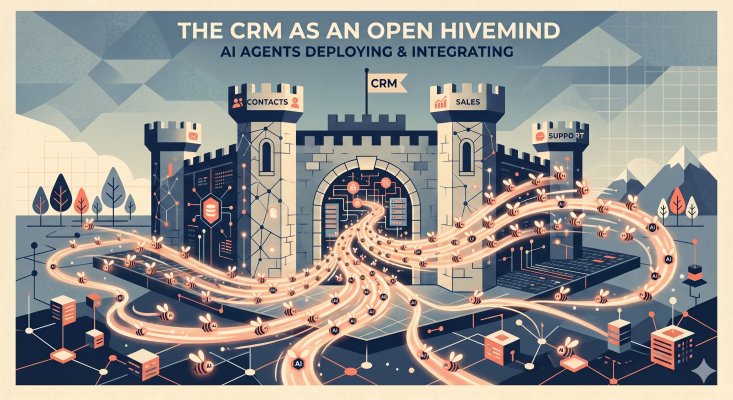
On 15 April 2026 in San Francisco, Salesforce unveiled Headless 360 as what they called the most ambitious architectural transformation in their 27-year history. In plain English: every capability Salesforce has ever built — every object, every flow, every workflow, every piece of business logic — is now exposed as an API, a Model Context Protocol (MCP) tool, or a CLI command.
Translation: you don't need the Salesforce UI anymore. You can talk to Salesforce through Claude, ChatGPT, Gemini, Slack, WhatsApp, or your grandma's custom-built chatbot, as long as it speaks MCP.
The launch shipped with more than 60 new MCP tools, 30 preconfigured coding skills, a reworked Agentforce Experience Layer that renders native UI components inside Slack, ChatGPT, Claude and Teams, and Agentforce Vibes 2.0 which plugs directly into Claude Code, Cursor, Codex and Windsurf. Salesforce is claiming a 40% reduction in DevOps cycle times, which I will believe when I see them clear their Ideas backlog, but is plausible if even half true.
The four-layer stack they are pitching is clean: Data 360 at the bottom, Customer 360 above that, Agentforce in the middle, and Slack as the conversational shell. Every layer is programmable. Every layer is accessible from anywhere.
Constellation Research analyst Holger Mueller called it "one to two years ahead" of their peers. For a company often accused of being slow and enterprise-y, that is a statement.
Why I'm Bullish: I've Been Living This Reality for Six Months
Let me tell you about my last three months, because it is the best evidence I can offer that this is the direction things are going, whether the ecosystem likes it or not.
The Website I Built From a Chairlift
In February I was snowboarding in Japan. Tokyo, then up to the powder fields. Between runs, sitting on chairlifts with gloves on and breath fogging up my phone screen, I built my personal website (robinleonard.co) entirely through Telegram.
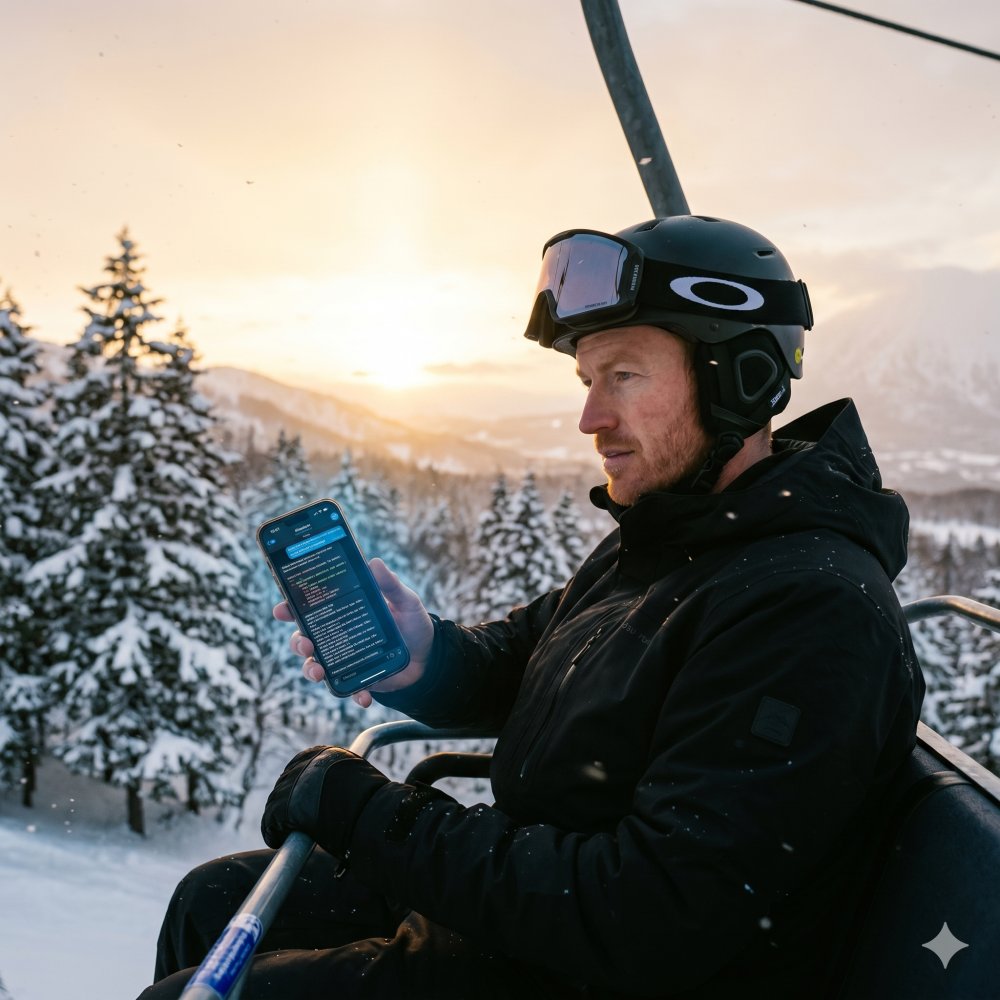
Not "designed a wireframe in Telegram". Not "drafted some copy". I built the actual site. Through a Telegram conversation with OpenClaw, the open-source AI agent harness that Austrian developer Peter Steinberger shipped back in November 2025 under the name Clawdbot. OpenClaw runs locally (or on a cloud server), hooks into Claude, OpenAI, Grok or whatever model you want, and exposes itself through whichever chat interface you prefer. In my case, Telegram on the chairlift.
I'd send a message. OpenClaw would think. It would write code. Push to a repo. Deploy. I'd scroll the result on my phone while the gondola slowly dragged itself up the mountain. Make a tweak. Send another message. Carve down the run. Come back up. Check the changes.
There is something deeply absurd about having built a functioning website between toilet breaks in a Japanese ski lodge. But the bit that struck me was not the novelty. It was that I never once thought about which interface to use. The interface was just Telegram, the same place I message my bros.
The Client Who Connected Claude to Snowflake
At roughly the same time, I was working with a client (anonymised, but think Retail with serious data volumes in Snowflake). Their exec team had been drowning in reporting requests, and they don't have a BI team.
They connected Claude directly to Snowflake through MCP. Gave it read access to the semantic layer, documentation on which tables mean what, and let the execs just ask questions in plain English.
“How did churn look last quarter broken down by cohort age?”
“Which accounts have expanded more than 30% YoY and when did they last contact support?”
Answers in seconds. With charts. Access given to everybody. Within two weeks, they no longer struggled with reporting requests and no BI capability, and the exec team had stopped asking us for insights, and started asking Claude directly.
That is what agentic reporting looks like in practice. It is not a chatbot bolted onto a dashboard. It is the dashboard, gone. Just ask. Just answer.
The Thesis: The "Everything Assistant" Is the Interface
Put those two stories together with what Salesforce just announced, and a pattern emerges that I don't think most people have fully registered.
Software used to be about the UI. Whole companies were built on the premise that if you could design a better form or a better table or a better pipeline view, you could win. Workday, ServiceNow, Salesforce, all of them won on being better workflows than the thing they replaced.
But the correct interface for humans in 2026 is not a better form. It is a chat window where you describe what you want, and a capable assistant, backed by your entire stack, figures out how to make it happen.
A dynamic chat interface that acts as your everything assistant is the future of enterprise software. Most people haven't clocked it yet because they are still imagining it as "a chatbot that does my expenses". It is much bigger than that. It is: one conversation, connected to every system, that knows your context, executes on your behalf, and renders whatever UI it needs to render inline, right inside that conversation.
Salesforce just made that possible for the biggest CRM estate on the planet. That is why this matters.
What I Might Be Missing: The Bits That Keep Me Up at Night
Right. Now the bit where I try to kick my own argument. Because any time I am this bullish, I'd rather find the holes myself than have a commenter find them first.
The Builder Gap
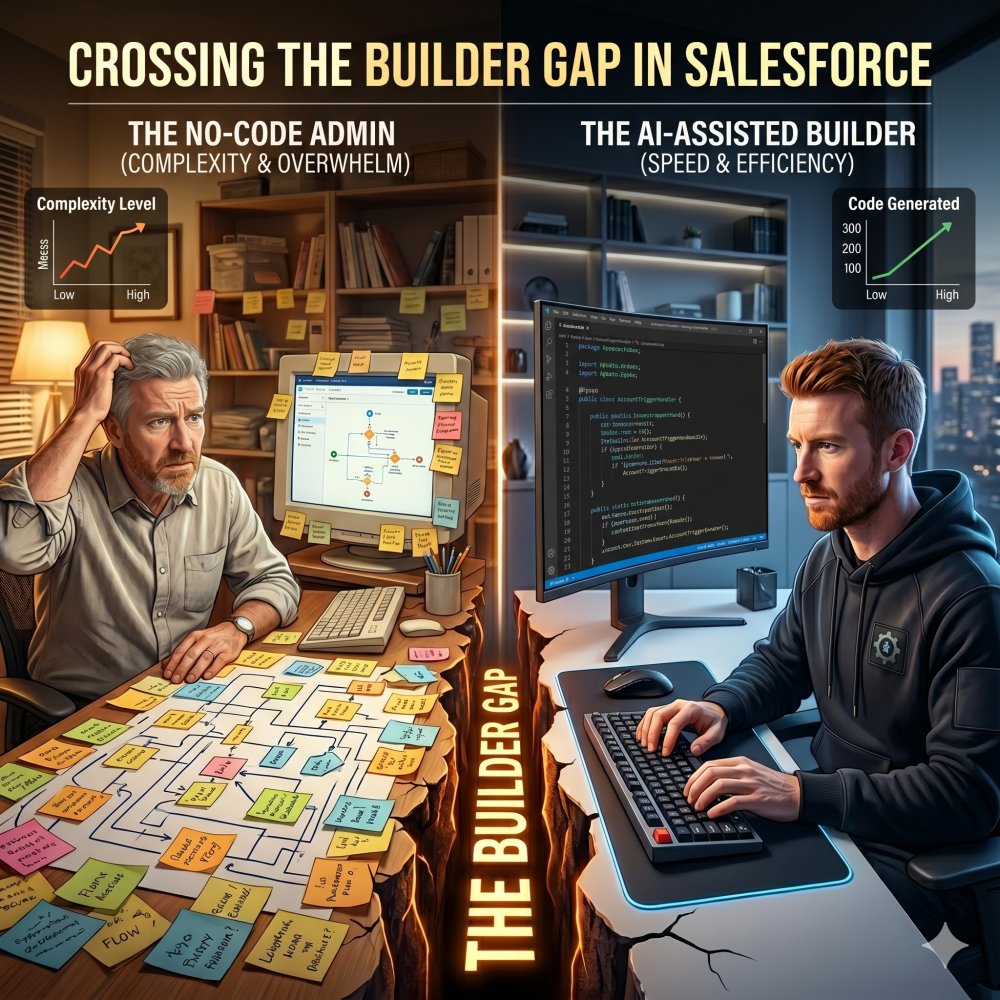
Vernon Keenan over at SalesforceDevops.net has been ringing a bell about this and I think he is right. His phrase is the "Builder Gap":
“On one side: a new generation of AI-native developers who can build on Salesforce without ever having been Salesforce developers. On the other: the existing ecosystem of admins and declarative builders who are watching the platform's centre of gravity shift toward tooling they weren't trained to use.”
For twenty years, the Salesforce ecosystem was built on Trailblazers. Admins. Flow builders. Low-code power users who delivered enormous business value without writing a single line of real code. These are the people who built the Salesforce install base, and they are absolutely not the target of Headless 360.
As Keenan put it bluntly: "Salesforce Headless 360 is a play for the Claude-pilled generation. But the Trailblazers who built the ecosystem still aren't invited to this party."
This is a genuine risk. Headless 360, MCP tools, Agent Script, hosted MCP servers, native React components. It is a pro-code menu dressed up in vibe-coding marketing. If Salesforce loses the admin community before the AI-native builder community shows up at scale, they have a nasty hole in their go-to-market.
The Seat-Based Pricing Problem
The whole reason Salesforce stock has been getting hammered (the iShares software ETF was down roughly 28% from its September 2025 peak when Headless 360 launched) is the same reason this move is brave.
If your agents are doing the work, who pays for the seat?
Salesforce has started shifting Agentforce to consumption-based pricing, which their own leadership has publicly called a "business model change and innovation for us". That is polite exec-speak for "we are ripping up the pricing model that made us north of $35 billion a year and hoping the new one catches the ball". The investor class is not yet convinced.
The Reliability Question
APIs are deterministic. Agents are probabilistic. As Diginomica nicely framed it, the developer shift Salesforce is asking for is the shift "from determinism to probabilism."
That is fine when Claude is helping me organise my emails. It is less fine when it is approving a $2M deal registration on behalf of a sales rep. The SLAs on MCP tool calls, how agents handle errors, how you audit what an agent did and why, all of that is extremely early. Analysts are already flagging that Salesforce's announcement was silent on MCP tool call SLAs. That silence is loud.
Headless Marketing: Actually the Hardest Bit
Everyone is talking about headless CRM. Nobody is really talking about what headless marketing looks like, and Salesforce's own Marketing Cloud Next rebuild is the most interesting example of what is coming.
Marketing Cloud Next, previewed at Connections '25 and rolling out through Spring '26, flips marketing from push to conversation. Their pitch is "every channel becomes a two-way conversation". Email replies become agent-handled intent. SMS becomes threaded. Campaigns get drafted inside an Agentforce chat against a brand brief you uploaded as a PDF.
The concept is exciting. The execution is a minefield.
Marketers have spent twenty years optimising for "do-not-reply" batch-and-blast. The entire deliverability infrastructure, from DMARC to reply-to routing to unsubscribe management, assumes one-way. Going two-way means engaging replies at scale, and that means agents need to handle objections, questions, abuse, angry customers, legal requests, and the occasional person trying to jailbreak your brand voice. In real time. Across email, SMS, WhatsApp, wherever.
This is where I think the ecosystem is genuinely underestimating the problem. It is not a tech problem. It is an operational and legal one. Who is accountable when an agent makes a promise in a two-way email that your brand can't keep? GDPR-style consent models were not designed for conversational marketing. None of the existing martech operating models were.
Headless marketing is going to be bloody hard. I suspect the first twelve months will be mostly cleaning up messes rather than delivering the promised value.
The Composable Tax
MarTech analysts have been warning for a while that composable stacks sound great in slide decks and get ugly in production. The phrase I liked was "a persistent engineering tax, not a one-time setup cost". APIs break. Schemas change. Dependencies multiply. If you are small, you cannot afford this. If you are large, you already have a platform team, but you still have to pay them to keep the whole chorus in tune.
Headless 360 is a beautiful architectural idea. It is also a commitment to having real engineering capacity in your organisation, which a lot of Salesforce customers, frankly, do not.

Where I Still Land: Bullish, With Scar Tissue
Every big shift in enterprise software has gone through this pattern. The UI people said the web would never replace client-server. The on-prem people said SaaS was a toy. The declarative people said low-code would fix everything. The headless people will be wrong about a few things too, and the chat-interface-is-everything people (that's me) will be wrong about some things as well.
But the direction of travel is unmistakable. Talking to your software, rather than clicking through it, is the default interface for the next decade. Salesforce has just committed the whole platform to that future. Benioff, bless, told CNBC earlier this year that "the software industry is still alive, well and growing." Headless 360 is his attempt to make that true by tearing down the walls of the platform that made his company famous.
If I am right, the companies that win are the ones who stop designing better page layouts and start designing better conversations. If I am wrong, at least I got to build a website from a Japanese chairlift, and that is a perfectly acceptable consolation prize.
---
Originally published on LinkedIn on 22 April 2026.
